ICSE Class 10
Physics
Work, Energy and Power — Chapter Test
Time: 20 min
Maximum marks: 20
General instructions: Answer all questions. Marks are shown in brackets [ ].
Objective
-
1.
[1]Which of the following values correctly represents 1 kWh in joules?
- A. 3.6 × 10³ J
- B. 3.6 × 10⁶ J
- C. 3.6 × 10⁵ J
- D. 3.6 × 10⁴ J
-
2.
[1]What is meant by the kinetic energy of a body?
- A. The energy possessed by a body due to its motion.
- B. The energy stored in a body due to its position or shape.
- C. The force required to bring a moving body to rest.
- D. The work done by a body when it comes to rest.
-
3.
[1]A ball of mass 200 g falls from a height of 5 m. What is its kinetic energy when it just reaches the ground? (Take g = 9.8 ms⁻²)
- A. 4.9 J
- B. 9.8 J
- C. 19.6 J
- D. 2.45 J
-
4.
[1]Which of the following correctly defines the term energy and states its S.I. unit?
- A. Energy is the capacity to do work. Its S.I. unit is the joule (J).
- B. Energy is the force applied to an object. Its S.I. unit is the newton (N).
- C. Energy is the rate of doing work. Its S.I. unit is the watt (W).
- D. Energy is the distance moved per unit time. Its S.I. unit is the meter per second (m/s).
-
5.
[1]SI unit of power is
- A. joule. hour.
- B. watt
- C. watt hour
- D. kilowatt
-
6.
[1]Which of the following correctly expresses the relationship between 1 kWh and 1 J?
- A. 1 kWh = 1000 J
- B. 1 kWh = 3.6 × 10³ J
- C. 1 kWh = 3.6 × 10⁶ J
- D. 1 kWh = 36 × 10⁵ J
-
7.
[1]A body of mass 5 kg is thrown vertically upwards with an initial velocity of 10 m/s. Calculate the work done by gravity when the body reaches its maximum height. (Take g = 9.8 m/s²).
- A. -250 J
- B. 250 J
- C. -490 J
- D. 50 J
-
8.
[1]A truck weighing $5 \times 10^{3}\,\mathrm{kgf}$ and a cart weighing $500\,\mathrm{kgf}$ are moving with the same speed. How do their kinetic energies compare?
- A. The kinetic energy of the truck is 10 times that of the cart.
- B. The kinetic energy of the cart is 10 times that of the truck.
- C. The kinetic energy of the truck is 5 times that of the cart.
- D. Both have the same kinetic energy since their speeds are equal.
-
9.
[1]A ball of mass 0.20 kg is thrown vertically upwards with an initial velocity of 20 ms⁻¹. What is the maximum potential energy it gains as it goes up?
- A. 20 J
- B. 40 J
- C. 60 J
- D. 80 J
-
10.
[1]Which graph correctly represents the potential energy vs height for a body thrown vertically upwards, assuming no friction is present?
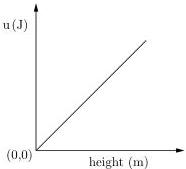
- A. A straight line with positive slope starting from zero at ground level.
- B. A straight line with negative slope starting from zero at ground level.
- C. A parabolic curve opening upwards.
- D. A horizontal line at a constant potential energy.
-
11.
[1]A coolie X carrying a load on his head climbs up a slope and another coolie Y carrying the identical load on his head moves the same distance on a frictionless horizontal platform. Who does more work?
- A. Coolie X does more work because he works against gravity.
- B. Coolie Y does more work because the platform is frictionless.
- C. Both coolies do the same work since the load and distance are identical.
- D. Neither coolie does any work because the load is carried on the head.
-
12.
[1]If the speed of a car is halved, how does its kinetic energy change?
- A. It becomes one-fourth of its original value.
- B. It becomes half of its original value.
- C. It becomes one-eighth of its original value.
- D. It doubles its original value.
-
13.
[1]An ox can apply a maximum force of 1000 N. It is taking part in a cart race and is able to pull the cart at a constant speed of 30 m s⁻¹ while making its best effort. What is the power developed by the ox?
- A. 30 W
- B. 3 kW
- C. 30 kW
- D. 300 kW
-
14.
[1]A body is thrown vertically upwards. Its velocity keeps on decreasing. What happens to its kinetic energy as its velocity becomes zero?
- A. Kinetic energy remains constant.
- B. Kinetic energy reduces to zero.
- C. Kinetic energy increases.
- D. Kinetic energy converts into heat.
-
15.
[1]What is meant by degradation of energy, illustrated with an example from daily life?
- A. The complete loss of energy from a system, such as a car engine stopping when fuel runs out.
- B. The conversion of energy into an undesirable or non-useful form, like an incandescent bulb producing more heat than light.
- C. The transfer of energy from one object to another without any loss, such as a ball bouncing perfectly.
- D. The increase in energy efficiency over time, like modern LED bulbs using less power than older bulbs.
-
16.
[1]Calculate the kinetic energy of a body of mass 5 kg momentum 50 kg ms⁻¹.
- A. 250 J
- B. 158 J
- C. 375 J
- D. 279 J
-
17.
[1]The bob of a simple pendulum is imparted a velocity of 5 m s⁻¹ when it is at its mean position. To what maximum vertical height will it rise on reaching its extreme position if 60% of its energy is lost in overcoming the friction of air? (Take g = 10 m s⁻²).
- A. 0.5 m
- B. 0.75 m
- C. 1.25 m
- D. 2.0 m
-
18.
[1]An electric pump is 60% efficient and is rated 2 HP. Calculate the maximum amount of water it can lift through a height of 5 m in 40 s. [Take g = 10 ms⁻² and 1 HP = 750 W]
- A. 25 kg
- B. 38 kg
- C. 720 kg
- D. 280 kg
-
19.
[1]A boy pulls a toy car with a force of 50 N through a string making a 30° angle with the horizontal, moving it 1 m horizontally. If the string were inclined at 45°, what force would he need to apply along the string to move it the same 1 m distance? (Given cos 30° = 0.8667, cos 45° = 0.7071)
- A. 61.27 N
- B. 50.00 N
- C. 70.71 N
- D. 86.60 N
-
20.
[1]Two bodies of masses m₁ and m₂ have the same linear momenta. The ratio of their kinetic energies is:
- A. m₁ : m₂
- B. m₂ : m₁
- C. m₁² : m₂²
- D. √m₁ : √m₂
— End of paper —
New to AI Exam Master?
Chapter-wise practice, mock tests, AI tutor & the full ICSE syllabus — see everything on the main site.