ICSE Class 10
Physics
Sound — Chapter Test
Time: 20 min
Maximum marks: 20
General instructions: Answer all questions. Marks are shown in brackets [ ].
Objective
-
1.
[1]An ultrasonic wave is sent from a ship towards the sea bottom, with a 1.5 s interval between sending and receiving. If the velocity of sound in seawater is 1400 ms⁻¹, what is the depth of the sea?
- A. 700 m
- B. 1050 m
- C. 1400 m
- D. 2100 m
-
2.
[1]Which of the following correctly differentiates sound waves from light waves?
- A. Sound waves are transverse, while light waves are longitudinal.
- B. Sound waves require a medium, while light waves do not.
- C. Sound waves travel faster than light waves in a vacuum.
- D. Sound waves have higher energy than light waves.
-
3.
[1]Which of the following best describes mechanical waves?
- A. Waves that can travel through a vacuum
- B. Waves that require a material medium for propagation
- C. Waves produced only by electronic devices
- D. Waves that change frequency in different media
-
4.
[1]The shrillness or pitch of a sound is determined by its:
- A. speed
- B. frequency
- C. loudness
- D. all these
-
5.
[1]Select a correct option with respect to echo depth sounding.
- A. Infrasonic waves are used.
- B. The frequency of the waves used is between $20\mathrm{Hz}$ and $20000\mathrm{Hz}$.
- C. Ultrasonic waves are used.
- D. Supersonic waves are used.
-
6.
[1]What is the minimum distance between a source of sound and the reflector required to hear an echo distinctly?
- A. 10 m
- B. 17 m
- C. 34 m
- D. 50 m
-
7.
[1]Bats, despite lacking eyes, can determine the distance, direction, nature, and size of objects. What mechanism enables them to do this?
- A. Detection of infrared radiation emitted by objects.
- B. Emission and detection of ultrasonic waves for echolocation.
- C. Use of magnetic fields to sense object positions.
- D. Relying on air currents and temperature gradients.
-
8.
[1]A certain sound has a frequency of 256 hertz and a wavelength of 1.3 m. Calculate the speed with which this sound travels.
- A. 332.8 m s⁻¹
- B. 196.9 m s⁻¹
- C. 307.2 m s⁻¹
- D. 450.6 m s⁻¹
-
9.
[1]Water from a tap is allowed to fall in a vessel with a thin neck. The pitch of sound produced by falling water ... with the volume of water in the vessel.
- A. increases
- B. decreases
- C. remains same
- D. none of these
-
10.
[1]Two strings of a guitar are of lengths 40 cm and 20 cm, made from the same material and of the same thickness, under the same tension. If the frequency of the longer wire is 250 Hz, what is the frequency of the smaller wire?
- A. 125 Hz
- B. 250 Hz
- C. 500 Hz
- D. 750 Hz
-
11.
[1]A sound wave is reflected from a brick wall. Compared with the incident wave, the reflected wave has:
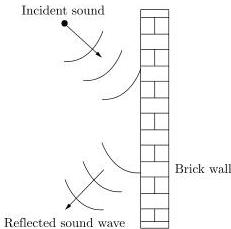
- A. a greater amplitude
- B. a shorter wavelength
- C. the same velocity
- D. the same speed
-
12.
[1]A vibrating tuning fork is held close to the ear, producing a faint hum. When the same tuning fork is placed on a table with its handle in contact, a loud sound is heard. Why does this happen?
- A. The table amplifies the sound due to forced vibrations
- B. The tuning fork vibrates faster on the table
- C. The table reduces air resistance
- D. The tuning fork loses energy in air
-
13.
[1]Why does the amplitude of a vibrating body continuously decrease during damped vibrations?
- A. Energy is lost as heat due to friction and resistive forces.
- B. The vibrating body gains energy from the surroundings.
- C. The frequency of vibration decreases over time.
- D. The mass of the vibrating body reduces gradually.
-
14.
[1]Sound made in front of a tall building 18 m away is repeated. Name the phenomenon and the reason it occurs. (a) A tuning fork, held over an air column of a given length, produces a distinct audible sound. What is this phenomenon called?
- A. Echo due to reflection; Resonance due to matching frequencies.
- B. Reverberation due to absorption; Interference due to wave superposition.
- C. Diffraction due to bending; Beats due to frequency difference.
- D. Refraction due to speed change; Doppler effect due to motion.
-
15.
[1]If a string is set into vibration on the surface of the moon, will the sound produced be audible to a human ear? Why or why not?
- A. Yes, because sound can travel through solids on the moon
- B. No, because the moon has no atmosphere to propagate sound waves
- C. Yes, because vibrations create sound regardless of the medium
- D. No, because the moon's gravity is too weak to produce sound
-
16.
[1]Which of the following are the two conditions required for an echo to take place?
- A. A solid reflecting surface and a minimum distance of 17 meters.
- B. A liquid medium and a distance of at least 1 meter.
- C. A vacuum and a time delay of 0.5 seconds.
- D. A gaseous medium and a frequency above 20 kHz.
-
17.
[1]Two musical notes of the same pitch and loudness are played on a violin and a piano, producing different waveforms. What causes this difference?
 Violin
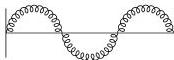
- A. The instruments produce different pitches despite the same note.
- B. The instruments have different timbres due to varying overtones and harmonics.
- C. The instruments emit sound at different velocities.
- D. The instruments use different types of waves (mechanical vs. electromagnetic).
-
18.
[1]Which of the following correctly defines the relationship between loudness (L) and intensity (I) of sound, where I₀ is the threshold of hearing?
- A. L = I / I₀
- B. L = log₁₀(I / I₀)
- C. L = I × I₀
- D. L = 10^(I / I₀)
-
19.
[1]A pendulum vibrates at 4 vibrations per second. An observer starts the pendulum and fires a gun simultaneously. The echo from a cliff is heard after 6 vibrations of the pendulum. Given the speed of sound is $340\,\mathrm{ms}^{-1}$, what is the distance between the cliff and the observer?
- A. $255.00\,\mathrm{m}$
- B. $127.50\,\mathrm{m}$
- C. $63.75\,\mathrm{m}$
- D. $85.00\,\mathrm{m}$
-
20.
[1]A wire of length 80 cm vibrates at 256 Hz. What length of a similar wire under the same tension will vibrate at 1024 Hz?
- A. 10 cm
- B. 20 cm
- C. 40 cm
- D. 60 cm
— End of paper —
New to AI Exam Master?
Chapter-wise practice, mock tests, AI tutor & the full ICSE syllabus — see everything on the main site.