ICSE Class 10
History and Civics
Gandhian Era and the Struggle for Independence — Chapter Test
Time: 20 min
Maximum marks: 10
General instructions: Answer all questions. Marks are shown in brackets [ ].
Objective
-
1.
[1]What was the aim of the Dandi March led by Mahatma Gandhi?
- A. To protest the Jallianwala Bagh Massacre
- B. To break the salt law
- C. To demand the release of political prisoners
- D. To promote Indian industries
-
2.
[1]When was the Quit India Resolution passed?
- A. 1940
- B. 1942
- C. 1945
- D. 1939
-
3.
[1]Who was the British leader who led the Cripps Mission?
- A. Winston Churchill
- B. Lord Mountbatten
- C. Sir Stafford Cripps
- D. Lord Curzon
-
4.
[1]Why was the Rowlatt Act passed by the British government in 1919?
- A. To grant greater political rights and autonomy to Indians as part of reforms.
- B. To suppress political unrest and dissent following widespread agitation.
- C. To promote industrial development and economic growth in India.
- D. To establish a system of local self-government in rural areas.
-
5.
[1]Why did the Congress ministries resign from the provincial governments in 1939?
- A. To protest the British decision to involve India in World War II without consultation.
- B. Due to internal conflicts within the Congress party.
- C. To support the British war efforts unconditionally.
- D. Following Gandhi's directive to launch the Quit India Movement.
-
6.
[1]Which of the following best describes the concept of Satyagraha as developed by Mahatma Gandhi?
- A. A violent uprising against colonial rule to achieve independence.
- B. A philosophy of non-violent resistance using truth and soul force to oppose injustice.
- C. A strategy of diplomatic negotiations with the British for gradual reforms.
- D. A method of armed rebellion to overthrow the British government.
-
7.
[1]What was the Gandhi-Irwin Pact of 1931?
- A. Agreement to end the Quit India Movement
- B. Agreement to withdraw the Civil Disobedience Movement
- C. Agreement on joint talks for self-rule
- D. Agreement on the partition of India
-
8.
[1]Which of the following was NOT a feature of the Programme of the Civil Disobedience Movement launched in 1930?
- A. Salt was used as a unifying symbol to mobilize Indians across different classes.
- B. The movement aimed to ignite patriotic fervor and raise political awareness among the masses.
- C. The movement established the Harijan Sevak Sangh to improve the social status of untouchables.
- D. The movement focused solely on achieving dominion status without addressing social reforms.
-
9.
[1]How did the British government's response to the Nehru Report of 1928 contribute to the launch of the Civil Disobedience Movement?
- A. It accepted the demand for self-governance immediately.
- B. It rejected the Nehru Report, increasing demands for complete independence.
- C. It proposed a new constitution based on the Nehru Report.
- D. It declared India a Dominion State in 1928.
-
10.
[1](i) The image below shows two male personalities. Identify the Indian leader among them and select the option that lists four of his ideological tenets.
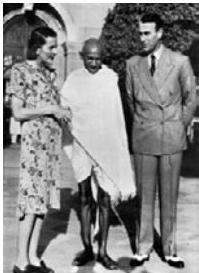
- A. Non-violence, Satyagraha, Swadeshi, Communism
- B. Non-violence, Satyagraha, Swadeshi, Truth
- C. Violence, Swaraj, Swadeshi, Truth
- D. Non-violence, Satyagraha, Industrialization, Truth
— End of paper —
New to AI Exam Master?
Chapter-wise practice, mock tests, AI tutor & the full ICSE syllabus — see everything on the main site.