ICSE Class 10
Biology
Genetics — Basic Fundamentals — Chapter Test
Time: 20 min
Maximum marks: 20
General instructions: Answer all questions. Marks are shown in brackets [ ].
Objective
-
1.
[1]In the context of tongue rolling, which one of the following correctly identifies the homozygous dominant and homozygous recessive genotypes from the given options: Rr, rr, RR?
- A. Homozygous dominant: RR, Homozygous recessive: Rr
- B. Homozygous dominant: RR, Homozygous recessive: rr
- C. Homozygous dominant: Rr, Homozygous recessive: rr
- D. Homozygous dominant: rr, Homozygous recessive: RR
-
2.
[1]Who is known as the "Father of Genetics"?
- A. Charles Darwin
- B. Gregor Johann Mendel
- C. Alfred Wallace
- D. Jean-Baptiste Lamarck
-
3.
[1]Which chromosome carries the gene for colorblindness?
- A. Y chromosome
- B. Z chromosome
- C. X chromosome
- D. W chromosome
-
4.
[1]What is the technique called where the genetic constitution of an organism is altered by introducing new genes into its chromosomes?
- A. Genetic mutation
- B. Genetic engineering
- C. Cloning
- D. Gene therapy
-
5.
[1]Which plant did Mendel use for his experiments on genetics?
- A. Corn
- B. Wheat
- C. Garden pea (Pisum sativum)
- D. Sunflower
-
6.
[1]Which one of the following is the phenotypic monohybrid ratio in F₂ generation?
- A. 3 : 1
- B. 1 : 2 : 1
- C. 2 : 2
- D. 1 : 3
-
7.
[1]Which of the following did Mendel achieve by removing reproductive parts of the flower in pea plants?
- A. Improved plant growth
- B. Prevented self-pollination
- C. Enhanced genetic variation
- D. Increased flower size
-
8.
[1]Which of the following is NOT a reason Mendel selected garden pea for his experiments?
- A. The plant could not be easily artificially pollinated
- B. It has a short life cycle
- C. Many varieties were available in alternative forms
- D. It produces a large number of offspring in a single generation
-
9.
[1]Riya is conducting a genetics experiment with pea plants and wants to prevent self-pollination to allow cross-pollination. What method did Mendel use to prevent self-pollination in pea plants?
- A. Removing corresponding reproductive parts
- B. Natural pollination
- C. Artificial cross-pollination
- D. Chemical treatment
-
10.
[1]Which of the following correctly explains how sex is determined in humans?
- A. The female parent determines the sex of the child by contributing either an X or Y chromosome.
- B. If the sperm bearing the X chromosome fertilizes the ovum, the zygote is XY, resulting in a male child.
- C. If the sperm bearing the Y chromosome fertilizes the ovum, the zygote is XY, resulting in a male child.
- D. The male and female parents each contribute an X chromosome, resulting in a female child.
-
11.
[1]The condition in which a pair of chromosomes carry similar alleles of a particular character is called:
- A. Homozygous
- B. Heterozygous
- C. Hemizygous
- D. Polyploid
-
12.
[1]What is the technique called where the genetic constitution of an organism is altered by introducing new genes into its chromosomes?
- A. Genetic mutation
- B. Genetic engineering
- C. Cloning
- D. Gene therapy
-
13.
[1]Does the sex of the child depend on the father or is it just a matter of chance?
- A. The sex of the child depends on the father because he contributes either an X or Y chromosome.
- B. The sex of the child is determined by the mother since she only provides an X chromosome.
- C. The sex of the child is purely a matter of chance with no biological basis.
- D. Both parents equally determine the sex of the child through their chromosomes.
-
14.
[1]Can there be a heterozygous recessive genotype? Why or why not?
- A. No, because heterozygous individuals have one dominant and one recessive allele, so the recessive trait is not expressed.
- B. Yes, because heterozygous individuals can express both dominant and recessive traits simultaneously.
- C. No, because heterozygous individuals must have two identical alleles to be considered recessive.
- D. Yes, because the recessive allele can sometimes override the dominant allele in heterozygous individuals.
-
15.
[1]In a certain species of animals, black fur (B) is dominant over brown fur (b). When both parents are heterozygous (Bb) for black fur, which of the following correctly represents the expected genotype and phenotype of their offspring?
- A. Genotypes: 1 BB : 1 Bb : 1 bb; Phenotypes: 2 Black : 2 Brown
- B. Genotypes: 1 BB : 2 Bb : 1 bb; Phenotypes: 3 Black : 1 Brown
- C. Genotypes: 2 BB : 1 Bb : 1 bb; Phenotypes: 3 Black : 1 Brown
- D. Genotypes: 1 BB : 1 Bb : 2 bb; Phenotypes: 1 Black : 3 Brown
-
16.
[1]Genes
- A. Help in carrying gametes
- B. Encode fats and lipids
- C. Encode particular protein
- D. Help in DNA replication
-
17.
[1]In a certain species of animals, black fur (B) is dominant over brown fur (b). What are the possible genotypic and phenotypic ratios of the offspring when pure breeding parents of different colours are crossed?
- A. Genotypic ratio: 100% Bb; Phenotypic ratio: 100% Black fur
- B. Genotypic ratio: 1 BB : 1 bb; Phenotypic ratio: 1 Black : 1 Brown
- C. Genotypic ratio: 1 BB : 2 Bb : 1 bb; Phenotypic ratio: 3 Black : 1 Brown
- D. Genotypic ratio: 100% BB; Phenotypic ratio: 100% Black fur
-
18.
[1]What is the expected progeny of a marriage between a normal man and a carrier haemophilic woman?
- A. 50% normal sons, 50% carrier daughters
- B. All sons haemophilic, all daughters carriers
- C. All normal sons, all haemophilic daughters
- D. 50% haemophilic sons, 50% normal daughters
-
19.
[1](viii) A family has a history of colour blindness. During a genetic testing, it was found that the mother is a carrier of colour blindness (X²X) and the father has normal vision (XY). What is the probability of their sons being colour blind?
- A. 25%
- B. 50%
- C. 75%
- D. 0%
-
20.
[1]Work out the progeny in the following Punnett square for a marriage between a carrier woman (XX°) and a colour-blind man (X°Y). Which labelled cell in the diagram (img-15.jpeg) represents the genotype of a colour-blind daughter?
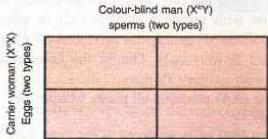
- A. The cell showing XX°
- B. The cell showing X°X°
- C. The cell showing XY
- D. The cell showing X°Y
— End of paper —
New to AI Exam Master?
Chapter-wise practice, mock tests, AI tutor & the full ICSE syllabus — see everything on the main site.