ICSE Class 10
Mathematics
Locus — Chapter Test
Time: 20 min
Maximum marks: 20
General instructions: Answer all questions. Marks are shown in brackets [ ].
Objective
-
1.
[1]In the diagram below, the line `l` represents the locus of a point equidistant from two fixed points A and B. Identify the correct label for the part marked `X` in the diagram `
 `.
`.- A. The midpoint of segment AB
- B. The perpendicular bisector of segment AB
- C. The angle bisector of ∠APB
- D. The median from P to segment AB
-
2.
[1]In the given diagram
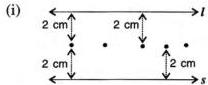 , a point P moves such that it remains equidistant from a fixed point O. Which of the following best describes the path (locus) traced by point P?
- A. A straight line passing through O
- B. A circle with O as the centre and the constant distance as radius
- C. A parabola with O as the focus
- D. An ellipse with O as one of its foci
-
3.
[1]Geometry made by a locus of a swimmer maintaining the same distance from a pole in water is:
- A. Circle
- B. Triangle
- C. Rectangle
- D. Square
-
4.
[1]Locus of a point whose distance from origin is always equal to is:
- A. $a^2 + b^2 = 2$
- B. $a^2 - b^2 = 4$
- C. $a^2 + b^2 = 4$
- D. $a^2 - b^2 = 2$
-
5.
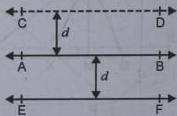
[1]Let a point P move in such a way that its distance from a fixed line AB is always equal to $d$ cm. The diagram below shows the fixed line AB and the path traced by P. Which labelled part represents the locus of the moving point P?
- A. A single straight line parallel to AB at a distance of $d$ cm from it.
- B. A pair of straight lines CD and EF, each parallel to AB at a distance of $d$ cm from it.
- C. A circle centered on AB with radius $d$ cm.
- D. A single straight line perpendicular to AB at a distance of $d$ cm from it.
-
6.
[1]A point $P$ moves two units above the $x$-axis at a constant distance. The locus of point $P$ is:
- A. $x = 2$
- B. $y = -2$
- C. $y = 2$
- D. $x = -2$
-
7.
[1]A point $Q$ is at the distance of 5 units from (3, 1). Equation of locus of point $D$ is:
- A. $x^{2} + y^{2} - 6x + 4y - 15 = 0$
- B. $x^{2} + 6x + 4y - 15 = 0$
- C. $x^{2} + y^{2} - 6x - 2y - 15 = 0$
- D. $x^{2} + y^{2} + 6x - 2y - 15 = 0$
-
8.
[1]On a graph paper, draw the lines $x = 3$ and $y = -5$. Now, on the same graph paper, what is the locus of the point which is equidistant from the given lines?
- A. The pair of lines $y = x - 2$ and $y = -x - 2$
- B. The single line $y = x + 2$
- C. The pair of lines $x = -5$ and $y = 3$
- D. The single line $y = -x + 2$
-
9.
[1]A point $P$ is equidistant from the points $(-2, 0)$ and $(3, 2)$. The locus of point $P$ is:
- A. $10x + 4y + 9 = 0$
- B. $10x + 4y + 8 = 0$
- C. $10x + 4y - 9 = 0$
- D. $10x - 4y + 9 = 0$
-
10.
[1]Given: CP is the bisector of angle C of Δ ABC.
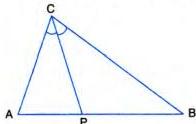 Which property explains why point P is equidistant from sides AC and BC?
- A. P lies on the angle bisector of ∠C, so it is equidistant from AC and BC.
- B. P is the midpoint of side AB, making it equidistant from AC and BC.
- C. P divides CP in the ratio of the adjacent sides, so distances are equal.
- D. P lies on the perpendicular bisector of AB, ensuring equal distances.
-
11.
[1]On a graph paper, draw the line $x = 6$. Now, on the same graph paper, draw the locus of the point which moves in such a way that its distance from the given line is always equal to 3 units. What is the resulting locus?
- A. A single line $x = 3$ parallel to $x = 6$.
- B. The pair of lines $x = 3$ and $x = 9$, each 3 units from $x = 6$.
- C. A circle centered at $x = 6$ with radius 3 units.
- D. The lines $y = 3$ and $y = -3$ intersecting $x = 6$.
-
12.
[1]The locus of vertices of all isosceles triangles having a common base will be the ... of the common base of the triangles:
- A. Perpendicular
- B. Perpendicular Bisector
- C. Bisector
- D. None of the above
-
13.
[1]A point P moves such that its distance from a fixed line AB is always the same. Which of the following best describes the path travelled by P?
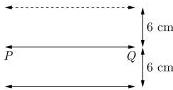
- A. A single line parallel to AB at the fixed distance.
- B. Two lines parallel to AB, each at the fixed distance from AB.
- C. A circle centered on AB with radius equal to the fixed distance.
- D. A parabola with AB as its directrix.
-
14.
[1]The locus of a point P such that ∠APB = 90° where AB is a fixed line is:
- A. Sphere
- B. Cube
- C. Circle
- D. Line
-
15.
[1]$AB$ is a fixed line. Which of the following is the locus of the point $P$ so that $\angle APB = 90^{\circ}$.
- A. Sphere
- B. Cube
- C. Circle
- D. Line
-
16.
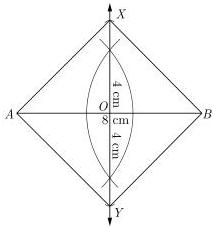
[1]Using ruler and compasses only, the diagram below shows the construction of a rhombus ABCD whose diagonals AC and BD are 8 cm and 6 cm long respectively. A point P is found by construction such that it is equidistant from AB, AD and also equidistant from C and D.
Which labelled part in the diagram represents the point P that satisfies the given conditions?
- A. The intersection of diagonal AC and the perpendicular bisector of CD
- B. The intersection of diagonals AC and BD
- C. The midpoint of diagonal AC
- D. The intersection of side AB and the angle bisector of angle BAD
-
17.
[1]
 Draw a triangle ABC such that BC = 6.3 cm, AB + AC = 10.5 cm, and ∠ABC = 60°. What is the position of point P such that PA = PB = PC?
- A. Intersection of the medians of triangle ABC
- B. Intersection of the perpendicular bisectors of BC and AC
- C. Intersection of the angle bisectors of triangle ABC
- D. Intersection of the altitudes of triangle ABC
-
18.
[1]Using ruler and compass only, construct a quadrilateral ABCD where AB = 6.5 cm, AD = 4 cm, and ∠DAB = 75°. Point C is equidistant from sides AB and AD and also equidistant from points A and B. How is point C located in the construction?
- A. At the intersection of AB and AD
- B. At the intersection of the angle bisector of ∠DAB and the perpendicular bisector of AB
- C. At the midpoint of AB
- D. At the intersection of AD and the perpendicular bisector of AB
-
19.
[1]Two straight lines PQ and PK cross each other at P at an angle of 75°. S is a stone on the road PQ, 800 m from P towards Q. Using a scale of 1 cm = 100 m, where is the flag staff X located if it is equidistant from P and S and also equidistant from the roads PQ and PK?
- A. At the intersection of PS and PK
- B. At the intersection of the perpendicular bisector of PS and the angle bisector of ∠KPS
- C. At the midpoint of PS
- D. At the intersection of PQ and the angle bisector of ∠KPS
-
20.
[1]Draw a Δ PQR such that QR = 7.5 cm, ∠PQR = 60°, and altitude PN = 4 cm. Inside the triangle, a point A is equidistant from PR and QR and also equidistant from P and R. Which construction step identifies point A?
- A. Intersection of the angle bisector of ∠P and the perpendicular bisector of QR
- B. Intersection of the angle bisector of ∠R and the perpendicular bisector of PR
- C. Intersection of the medians of Δ PQR
- D. Intersection of the altitudes of Δ PQR
— End of paper —
New to AI Exam Master?
Chapter-wise practice, mock tests, AI tutor & the full ICSE syllabus — see everything on the main site.