ICSE Class 10
Mathematics
Constructions — Chapter Test
Time: 20 min
Maximum marks: 20
General instructions: Answer all questions. Marks are shown in brackets [ ].
Objective
-
1.
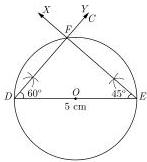
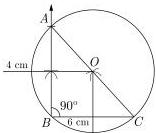
[1]Construct a triangle $ABC$, given $AB = 4$ cm, $BC = 6$ cm and $\angle ABC = 90^\circ$. What is the key step to construct the circle passing through points $A$, $B$, and $C$?
- A. Draw perpendicular bisectors of $AB$ and $BC$ intersecting at $O$.
- B. Draw angle bisectors of $\angle ABC$.
- C. Join $A$ to $C$ and measure $AC$.
- D. Draw a circle with radius $AB$.
-
2.
[1]Using ruler and compass, construct a $\Delta ABC$ where $AB = 3\mathrm{cm}$, $BC = 4\mathrm{cm}$ and $\angle ABC = 90^{\circ}$. What is the radius of the circle circumscribing $\Delta ABC$?
- A. $2$ cm
- B. $2.5$ cm
- C. $3$ cm
- D. $5$ cm
-
3.
[1]In the diagram
 showing the construction of an inscribed circle of triangle ABC, the point labelled I represents which of the following?
- A. The circumcentre, where the perpendicular bisectors of the sides meet
- B. The incentre, where the angle bisectors of the triangle meet
- C. The orthocentre, where the altitudes of the triangle meet
- D. The centroid, where the medians of the triangle meet
-
4.
[1]In the diagram showing the construction of the circumscribing circle of triangle ABC, which labelled point represents the circumcentre of the triangle?
- A. The point where two altitudes of the triangle intersect
- B. The point where the perpendicular bisectors of any two sides meet
- C. The midpoint of the longest side of the triangle
- D. The point where the angle bisectors of the triangle intersect
-
5.
[1]An equilateral triangle of side 4 cm is drawn. Which step is NOT part of constructing its circumcircle?
- A. Draw perpendicular bisectors of two sides
- B. Find the intersection of the bisectors as centre
- C. Draw arcs of radius 4 cm from all vertices
- D. Draw circle with radius equal to distance from centre to vertex
-
6.
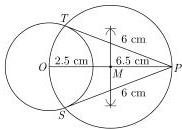
[1]Draw a circle of radius 2.5 cm. Mark a point P at a distance of 6.5 cm from the centre O of the circle. Using ruler and compass, draw two tangents to the circle from P and measure the length of each tangent. What is the length of each tangent?
- A. 4.0 cm
- B. 5.0 cm
- C. 6.0 cm
- D. 7.0 cm
-
7.
[1]In the diagram below, a regular hexagon with side 5 cm is shown. Which labelled part represents the radius of the circumscribed circle around the hexagon?
- A. The perpendicular bisector of a side of the hexagon
- B. The line segment from the center to a vertex of the hexagon
- C. The side length of the hexagon (5 cm)
- D. The line joining the midpoints of two opposite sides
-
8.
[1]Construct a regular hexagon of side $3.5$ cm. To construct its circumcircle, which of the following is the correct method?
- A. Draw perpendicular bisectors of two adjacent sides to find the centre.
- B. Use the intersection of diagonals as the centre of the circumcircle.
- C. Construct the incircle first and use its centre for the circumcircle.
- D. Find the midpoint of one side and use it as the centre.
-
9.
[1]Use ruler and compass only to draw a circle of radius 4 cm with centre O. Mark a point P outside the circle at a distance of 7 cm from O. Construct two tangents to the circle from P and measure the length of any one tangent. What is the length of one tangent?
- A. 4.5 cm
- B. 5.7 cm
- C. 6.0 cm
- D. 6.5 cm
-
10.
[1]Construct a regular hexagon of side 5 cm and inscribe a circle in it. Which of the following steps correctly identifies the centre of the incircle?
- A. The intersection of the perpendicular bisectors of any two sides.
- B. The intersection of the angle bisectors of any two interior angles.
- C. The midpoint of any side of the hexagon.
- D. The point where the diagonals of the hexagon meet.
-
11.
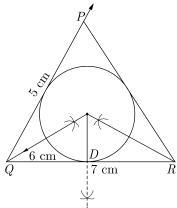
[1]Construct a $\Delta PQR$, given $PQ = 5$ cm, $QR = 7$ cm and $\angle PQR = 60^\circ$. To inscribe a circle in the triangle, which step is required?
- A. Draw perpendicular bisectors of $PQ$ and $QR$ to find the centre.
- B. Draw angle bisectors of $\angle Q$ and $\angle R$ intersecting at $I$.
- C. Construct the circumcircle and use its centre for the incircle.
- D. Find the midpoint of $PR$ and use it as the centre of the incircle.
-
12.
[1]Using ruler and compasses only, draw an equilateral triangle of side 5 cm and draw its inscribed circle as shown in the diagram. Which labelled part in the diagram represents the radius of the inscribed circle?
- A. The perpendicular distance from the incentre to any side of the triangle
- B. The distance from the incentre to any vertex of the triangle
- C. The length of the angle bisector from a vertex to the opposite side
- D. The distance between two sides of the triangle along a median
-
13.
[1]Using ruler and compass only, draw a circle of radius 4 cm with centre O. Mark a point P outside the circle at a distance of 7 cm from O. Construct two tangents to the circle from P and measure the length of any one tangent. What is the length of one tangent?
- A. 4.9 cm
- B. 5.7 cm
- C. 6.3 cm
- D. 7.0 cm
-
14.
[1]Draw a circle of radius 3 cm. Construct tangents to the circle so that the angle between them is 45°. What is the measure of the angle subtended by the two points of tangency at the centre of the circle?
- A. 45°
- B. 90°
- C. 135°
- D. 180°
-
15.
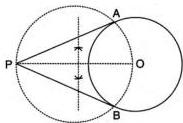
[1]In the given diagram,, a circle of diameter 9 cm is drawn, and a point P is marked at a distance of 7.5 cm from the centre O of the circle. Tangents PA and PB are drawn from P to the circle. Which labelled segment correctly represents the length of each tangent?
- A. OA = 4.5 cm
- B. OP = 7.5 cm
- C. PA = 6 cm
- D. AB = 9 cm
-
16.
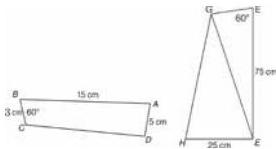
[1](i) Using a ruler and compass, construct a ΔABC with AB = 6 cm, AC = 4.5 cm, and ∠BAC = 120°. After constructing the triangle, measure and determine the radius of the circumscribed circle around ΔABC.
- A. 3 cm
- B. 4.5 cm
- C. 6 cm
- D. 7.5 cm
-
17.
[1]Using a ruler, construct a ΔABC with BC = 6.4 cm, CA = 5.8 cm, and ∠ABC = 60°. Draw its incircle. What is the radius of this incircle?
- A. 1.0 cm
- B. 1.5 cm
- C. 2.0 cm
- D. 2.5 cm
-
18.
[1]In the given diagram
 , the point labelled H represents the orthocentre of triangle ABC. Which of the following correctly describes how this point is determined?
- A. It is the point where the perpendicular bisectors of the sides of the triangle meet.
- B. It is the point where the altitudes of the triangle, drawn from each vertex to the opposite side, intersect.
- C. It is the point where the angle bisectors of the triangle meet.
- D. It is the point where the medians of the triangle intersect.
-
19.
[1]Construct a triangle ABC, given that AB = 4 cm, BC = 6 cm, and median AM = 3 cm. After constructing the triangle, a circle is circumscribed about it. Where is the centre of this circumcircle located?
- A. At the intersection of the perpendicular bisectors of AB and BC
- B. At the intersection of the perpendicular bisectors of AB and AC
- C. At the intersection of the medians of the triangle
- D. At the intersection of the angle bisectors of the triangle
-
20.
[1]Draw a circle of radius 4 cm. To construct two tangents to the circle inclined at an angle of 60° to each other, what should be the angle between the two radii at the points of contact?
- A. 30°
- B. 60°
- C. 120°
- D. 180°
— End of paper —
New to AI Exam Master?
Chapter-wise practice, mock tests, AI tutor & the full ICSE syllabus — see everything on the main site.