ICSE Class 10
Physics
Electricity and Magnetism — Chapter Test
Time: 20 min
Maximum marks: 20
General instructions: Answer all questions. Marks are shown in brackets [ ].
Objective
-
1.
[1]In an electrical appliance, which part is typically connected to the earth wire for safety?
- A. The plastic casing.
- B. The internal wiring.
- C. The metallic body of the appliance.
- D. The on/off switch.
-
2.
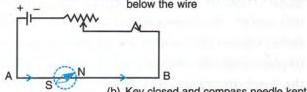
[1]In the diagram of an I-shaped (bar) electromagnet shown below, identify the part labelled X and Y that is essential for its operation.
- A. Thin insulated copper wire connected to a battery to carry current
- B. Soft iron bar acting as the core to strengthen the magnetic field
- C. Rheostat used to adjust the length of the solenoid
- D. Ammeter measuring the magnetic strength of the electromagnet
-
3.
[1]Resistivity of a material is defined as the resistance of a conductor of that material under which conditions?
- A. Of any length and any cross-sectional area.
- B. Of unit length and unit cross-sectional area.
- C. Of maximum length and minimum cross-sectional area.
- D. Of variable length and cross-sectional area.
-
4.
[1]Which of the following best describes a direct current (d.c.)?
- A. An electric current that reverses direction periodically.
- B. An electric current that flows in one constant direction.
- C. An electric current that varies in magnitude but not direction.
- D. An electric current that flows only in metals.
-
5.
[1]Which of the following is NOT a common use of electromagnets?
- A. Lifting and transporting heavy iron objects such as scrap, girders, and plates.
- B. Separating iron pieces from debris or ores, such as in copper mines.
- C. Generating permanent magnetic fields in bar magnets for compasses.
- D. Operating electrical devices like electric bells, motors, and loudspeakers.
-
6.
[1]Kilowatt hour is commercial unit of :
- a. heat energy
- b. mechanical energy
- c. power
- d. electric energy
-
7.
[1]Which of the following correctly states Faraday's first law of electromagnetic induction?
- A. An emf is produced in a coil only if the coil is moved through a magnetic field.
- B. Whenever the magnetic field through a coil changes, an emf is induced in the coil that lasts as long as the change continues.
- C. A coil must carry a steady current to produce an emf in a nearby coil.
- D. The emf induced in a coil is proportional to the number of turns only.
-
8.
[1]Two fuse wires of the same length are rated 5 A and 20 A. Which fuse wire is thicker, and why?
- A. The 5 A fuse wire, because thinner wires melt at lower currents.
- B. The 20 A fuse wire, because thicker wires have lower resistance and carry more current.
- C. Both are the same thickness, as length determines current rating.
- D. The 5 A fuse wire, because thicker wires are used for lower currents.
-
9.
[1]Which material is used for making the armature of an electric bell and why is this material chosen?
- A. Soft iron, because it is easily magnetized and demagnetized, allowing rapid movement.
- B. Steel, because it retains magnetism permanently, ensuring consistent performance.
- C. Copper, because it is a good conductor of electricity and reduces energy loss.
- D. Aluminum, because it is lightweight and resists corrosion effectively.
-
10.
[1]What effect will there be on a magnetic compass when it is brought near a current carrying solenoid?
- A. The compass needle will spin continuously due to the magnetic field.
- B. The compass needle will rest in the direction of the magnetic field due to the solenoid at that point.
- C. The compass needle will point perpendicular to the solenoid's axis, unaffected by the current.
- D. The compass needle will become demagnetized and stop functioning.
-
11.
[1]Amongst the following substance, the resistance will decrease with the increase in temperature in case of :
- a. copper
- b. nichrome
- c. brass
- d. carbon
-
12.
[1]State Fleming's left-hand rule and explain its application in determining the direction of rotation in a DC electric motor. Which of the following correctly describes this rule and its application?
- A. Stretch the thumb, forefinger, and middle finger of the left hand perpendicular to each other. The forefinger points in the magnetic field direction, the middle finger in the current direction, and the thumb in the force (motion) direction, causing the coil to rotate in a DC motor.
- B. Stretch the thumb, forefinger, and middle finger of the right hand perpendicular to each other. The forefinger points in the current direction, the middle finger in the magnetic field direction, and the thumb in the force direction, used in DC motors.
- C. Stretch the thumb, forefinger, and middle finger of the left hand perpendicular to each other. The thumb points in the magnetic field direction, the forefinger in the current direction, and the middle finger in the force direction, determining motor rotation.
- D. Stretch the thumb, forefinger, and middle finger of the left hand in the same plane. The forefinger points in the force direction, the middle finger in the magnetic field direction, and the thumb in the current direction, applied in DC motors.
-
13.
[1]A d.c. motor is rotating in a clockwise direction. Which of the following actions will reverse its direction of rotation?
- A. Increasing the voltage of the battery connected to the motor
- B. Interchanging the connections at the terminals of the battery joined to the brushes of the motor
- C. Replacing the permanent magnets of the motor with weaker ones
- D. Adding a resistor in series with the motor coil
-
14.
[1]What is the commercial unit of electrical energy, and how is it related to the S.I. unit of energy?
- A. The commercial unit is kilowatt-hour (kWh), and 1 kWh = 3.6 × 10^6 J.
- B. The commercial unit is joule (J), and 1 J = 1 kWh.
- C. The commercial unit is watt-hour (Wh), and 1 Wh = 3600 J.
- D. The commercial unit is kilowatt (kW), and 1 kW = 3.6 × 10^6 J/s.
-
15.
[1]A house is fitted with a motor of one horse power, 5 bulbs consuming 0.2 A each, and two fans of 80 W each. If all appliances work for five hours daily, what is the monthly bill? Energy costs 20 paise per unit at 220 V. (1 hp = 746 W)
- A. ₹ 25.00
- B. ₹ 33.78
- C. ₹ 42.50
- D. ₹ 50.00
-
16.
[1]Which of the following circuit arrangements correctly illustrates how to connect a key, a battery, a voltmeter, an ammeter, an unknown resistance R, and a rheostat to verify Ohm's law?
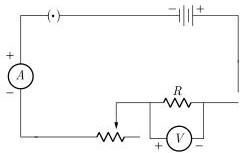
- A. Battery, key, ammeter, R, and rheostat in series; voltmeter in parallel with R.
- B. Battery, key, voltmeter, R, and rheostat in series; ammeter in parallel with R.
- C. Battery, key, ammeter, and voltmeter in series; R and rheostat in parallel.
- D. Battery, key, and rheostat in series; ammeter and voltmeter in parallel with the battery.
-
17.
[1]Electrostatic potential at a point is defined as the work done in moving:
- A. a unit positive charge from that point to infinity.
- B. a unit positive charge from infinity to that point.
- C. a unit negative charge from infinity to that point.
- D. a charge of 1 coulomb from that point to another point.
-
18.
[1]Which of the following best describes a non-ohmic conductor? Select the correct option and graph representation.
- A. Conductors that do not obey Ohm's law; e.g., diode valve. Graph is non-linear. ![][img-6.jpeg]
- B. Conductors that obey Ohm's law; e.g., copper wire. Graph is linear.
- C. Conductors with zero resistance; e.g., superconductors. Graph is horizontal.
- D. Conductors with infinite resistance; e.g., insulators. Graph is vertical.
-
19.
[1]Fig. 8.37 shows a battery of e.m.f. 9 V and internal resistance 0.6 Ω, connected to three resistors A, B, and C. In the diagram, the resistor labelled **X** is the parallel combination of resistors B and C. What is the correct label for **X** in the circuit?
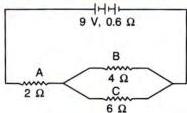
- A. 2.4 Ω (combined resistance of B and C)
- B. 4 Ω (resistance of B only)
- C. 6 Ω (resistance of C only)
- D. 4.4 Ω (total resistance of A, B, and C)
-
20.
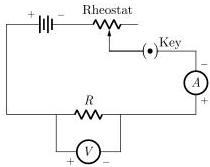
[1]In the experimental verification of Ohm's law, what does the slope of the V-i graph represent? (Refer to the circuit diagram and graph:
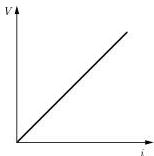 )
)- A. The power dissipated by the resistor
- B. The resistance of the conductor
- C. The current flowing through the circuit
- D. The voltage drop across the resistor
— End of paper —
New to AI Exam Master?
Chapter-wise practice, mock tests, AI tutor & the full ICSE syllabus — see everything on the main site.