ICSE Class 10
Physics
Light — Chapter Test
Time: 20 min
Maximum marks: 20
General instructions: Answer all questions. Marks are shown in brackets [ ].
Objective
-
1.
[1]The source of ultraviolet light is
- A. electric bulb
- B. red hot iron ball
- C. sodium vapour lamp
- D. carbon arc-lamp
-
2.
[1]Which lens has both the surfaces as concave?
- a. plano-convex
- b. plano-concave
- c. bi-convex
- d. bi-concave
-
3.
[1]A small air bubble in a glass block when seen from above appears to be raised because of
- A. refraction of light
- B. reflection of light
- C. reflection and refraction of light
- D. none of the above
-
4.
[1]A ray of light is incident normally on a glass slab. What is the angle of refraction?
- A. 0° because the ray passes undeviated when incident normally.
- B. 90° because the ray bends away from the normal in the denser medium.
- C. 45° as the ray splits equally between reflection and refraction.
- D. The angle depends on the refractive index of the glass slab.
-
5.
[1]A concave lens forms the image of an object which is
- A. virtual, inverted, and diminished
- B. virtual, upright, and diminished
- C. virtual, inverted, and enlarged
- D. virtual, upright, and enlarged
-
6.
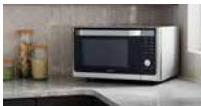
[1]The device used in the figure uses radiations to cook food.
- a. safe vault
- b. mini oven
- c. microwave oven
- d. none of these
-
7.
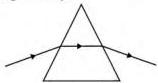
[1]In the position of minimum deviation for an equilateral prism, how is the angle of emergence related to the angle of incidence? Refer to the labelled diagram below to identify the correct relationship.
- A. The angle of emergence is twice the angle of incidence.
- B. The angle of emergence is equal to the angle of incidence.
- C. The angle of emergence is half the angle of incidence.
- D. The angle of emergence is independent of the angle of incidence.
-
8.
[1]Which of the two prisms, A made of crown glass and B made of flint glass, deviates a ray of light more?
- A. Prism A, because crown glass has a lower refractive index.
- B. Prism B, because flint glass has a higher refractive index.
- C. Prism A, because crown glass causes greater deviation due to its density.
- D. Both prisms deviate light equally since they are made of glass.
-
9.
[1]Where must a point source of light be placed in front of a convex lens so as to obtain a parallel beam of light?
- A. At the optical centre of the convex lens
- B. At the focus of the convex lens
- C. At twice the focal length from the convex lens
- D. Between the focus and the optical centre of the convex lens
-
10.
[1]Why does the surface of an empty test tube, kept in a beaker filled with water, appear shiny like a mirror?
- A. Light undergoes refraction at the water-air interface
- B. Light undergoes total internal reflection at the water-air interface
- C. The test tube absorbs all incident light
- D. The test tube reflects light due to its smooth surface
-
11.
[1]Arrange the following radiations in ascending order of their frequency: Visible light, infrared radiation, ultraviolet rays, γ-rays, X-rays, radio-waves, microwaves.
- A. Radio-waves, microwaves, infrared, visible light, ultraviolet, X-rays, γ-rays.
- B. Microwaves, radio-waves, infrared, visible light, ultraviolet, γ-rays, X-rays.
- C. Infrared, visible light, radio-waves, microwaves, ultraviolet, X-rays, γ-rays.
- D. Radio-waves, infrared, microwaves, visible light, X-rays, ultraviolet, γ-rays.
-
12.
[1]What are the characteristics of the image formed by a concave lens when an extended source is placed in front of it?
- A. Real, inverted, and diminished.
- B. Virtual, erect, and diminished.
- C. Real, erect, and magnified.
- D. Virtual, inverted, and magnified.
-
13.
[1]How does the critical angle depend on the colour of light?
- A. The critical angle is least for violet light and greatest for red light because refractive index decreases with increasing wavelength.
- B. The critical angle is the same for all colours of light since it depends only on the medium.
- C. The critical angle is greatest for violet light and least for red light because shorter wavelengths bend more.
- D. The critical angle increases with the frequency of light, making it least for red light.
-
14.
[1]The refractive index of water is $\frac{4}{3}$ and of glass is $\frac{3}{2}$. What is the refractive index of glass with respect to water?
- A. 0.889
- B. 1.125
- C. 1.500
- D. 0.667
-
15.
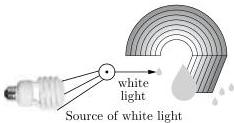
[1]In a science project, a student tried to show rainbow formation using artificial rain and strong source of white light as shown in figure below. What should be the position of observer to observe the rainbow?
- A. Looking towards the source
- B. Looking towards the raindrop such that he is equally inclined towards the source of raindrops
- C. Looking towards the raindrops with the source behind him
- D. Looking anywhere in the room
-
16.
[1]Light passes through a rectangular glass slab and through a triangular glass prism. How does the direction of the two emergent beams differ?
- A. Both emergent beams are deviated due to refraction.
- B. The slab’s emergent ray is parallel to the incident ray; the prism’s is deviated.
- C. The slab’s emergent ray is deviated; the prism’s is parallel to the incident ray.
- D. Both emergent beams emerge parallel to the incident ray.
-
17.
[1]A candle burns at some distance on one side of a glass box, and its image of the same size forms on a screen 0.20 m on the other side. What lens arrangement is in the box, and what is its power?
- A. Concave lens, -5 D
- B. Convex lens, +10 D
- C. Concave lens, -10 D
- D. Convex lens, +5 D
-
18.
[1]State T for true and F for false I. To recombine the spectrum to obtain white light, the dispersive prism and recombination prism should be in same position. II. If a glass prism is dipped in water, its dispersive power decreases. III. When sunlight comes down through the clouds, Tyndall effect is observed. IV. Headlights are made of yellow colour because of its long wavelength and low scattering.
|I II III IV - a. T | T | T | T
- b. F | T | T | T
- c. F | F | T | T
- d. F | T | F | T
-
19.
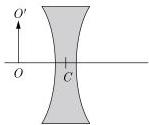
[1]In the given figure, OC = f (focal length of the lens). If rays are drawn from the linear object OO₁, how will the image be formed by the lens?
- A. Real, inverted, and magnified image at 2F.
- B. Virtual image formed at infinity with parallel emergent rays.
- C. Real, erect, and diminished image between F and the lens.
- D. No image formed as rays diverge after refraction.
-
20.
[1]Derive the relationship between the wavelength of light in air ($$\lambda$$) and in a medium ($$\lambda'$$) given the refractive index ($$\mu$$) of the medium. Which of the following correctly expresses this relationship?
- A. $$\lambda' = \mu \lambda$$
- B. $$\lambda' = \frac{\lambda}{\mu}$$
- C. $$\lambda' = \lambda \mu^2$$
- D. $$\lambda' = \lambda + \frac{1}{\mu}$$
— End of paper —
New to AI Exam Master?
Chapter-wise practice, mock tests, AI tutor & the full ICSE syllabus — see everything on the main site.