ICSE Class 10
Physics
Force, Turning Effects of Force, and Uniform Circular Motion — Chapter Test
Time: 20 min
Maximum marks: 20
General instructions: Answer all questions. Marks are shown in brackets [ ].
Objective
-
1.
[1]The moment of a force about a given axis depends
- A. only on the magnitude of force
- B. only on the perpendicular distance of force from the axis
- C. neither on the force nor on the perpendicular distance of force from the axis
- D. both, on the force and its perpendicular distance from the axis
-
2.
[1]What is meant by the equilibrium of a body?
- A. A body is in equilibrium when it is at rest or moving with constant velocity and not rotating.
- B. A body is in equilibrium when only the resultant force acting on it is zero, regardless of rotation.
- C. A body is in equilibrium when it is accelerating linearly but not rotating.
- D. A body is in equilibrium when the forces acting on it are balanced but moments may cause rotation.
-
3.
[1]Which of the following correctly defines the term 'centre of gravity of a body'?
- A. The point where the mass of the body is equally distributed in all directions.
- B. The point at which the entire weight of the body can be considered to act.
- C. The geometric centre of the body, regardless of its weight distribution.
- D. The point where the body experiences the maximum gravitational force.
-
4.
[1]Where is the centre of gravity of a uniform ring situated?
- A. At the centre of the ring.
- B. At the edge of the ring.
- C. Midway between the centre and the edge.
- D. Outside the ring, along its axis.
-
5.
[1]State one way to reduce the moment of a given force about a given axis of rotation.
- A. Increase the magnitude of the force applied.
- B. Reduce the perpendicular distance from the axis of rotation to the line of action of the force.
- C. Change the direction of the force to be parallel to the axis of rotation.
- D. Apply the force at a point farther from the axis of rotation.
-
6.
[1]The turning effect of a force depends on which of the following factors?
- A. The magnitude of the force and the angle at which it is applied
- B. The magnitude of the force and the perpendicular distance from the axis of rotation
- C. The mass of the object and the speed of the applied force
- D. The direction of the force and the surface area of the object
-
7.
[1]Which of the following correctly describes the position of the centre of gravity in unstable equilibrium?
- A. The centre of gravity is at its highest position (e.g., a cone on its apex).
- B. The centre of gravity is at its lowest position (e.g., a cone on its base).
- C. The centre of gravity remains at the same height (e.g., a rolling ball).
- D. The centre of gravity is at the midpoint of the object's height.
-
8.
[1]A fulcrum divides a crowbar in the ratio 3:1. What weight will be lifted if an effort of 100 N is applied at the end of its longer arm?
- A. 100 N
- B. 200 N
- C. 300 N
- D. 400 N
-
9.
[1]The centrifugal force is
- A. a real force
- B. the force of reaction of centripetal force
- C. a fictitious force
- D. directed towards the centre of circular path
-
10.
[1]A wheel is pivoted at its centre (O) as shown in the diagram
 . A force of 20 N is applied tangentially at a point on its rim, 0.3 m from the centre. Which labelled part or value correctly represents the moment of force produced?
- A. 6 N m (the product of 20 N and 0.3 m)
- B. 20 N (the applied force alone)
- C. 0.3 m (the radius of the wheel)
- D. 6.67 N m (20 N divided by 3 m)
-
11.
[1]Define moment of couple and identify its S.I. unit.
- A. The product of one force and the perpendicular distance between the forces; S.I. unit is newton-metre (Nm).
- B. The sum of two forces acting in opposite directions; S.I. unit is newton (N).
- C. The product of mass and acceleration; S.I. unit is kilogram-metre per second squared (kgm/s²).
- D. The perpendicular distance between two forces; S.I. unit is metre (m).
-
12.
[1]When does a body rotate? Which of the following is one way to change the direction of rotation of the body, along with a suitable example?
- A. A body rotates when an unbalanced force acts on it. Reverse the force direction; e.g., pushing a door handle left instead of right.
- B. A body rotates when an unbalanced moment acts on it. Reverse the direction of the applied force; e.g., turning a door handle clockwise instead of anticlockwise.
- C. A body rotates when its center of mass shifts. Increase the force magnitude; e.g., pushing a door harder to make it swing faster.
- D. A body rotates when friction is eliminated. Change the pivot point; e.g., moving the hinge of a door to the opposite side.
-
13.
[1]Assuming the centre of gravity of a uniform rod is at its midpoint, how is the position of the centre of gravity of a triangular lamina determined?
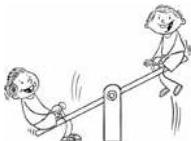
- A. It lies at the intersection of the medians of the triangle.
- B. It lies at the midpoint of the longest side of the triangle.
- C. It lies at the point where the altitudes of the triangle meet.
- D. It lies at the average of the vertices' coordinates.
-
14.
[1]A mechanic can open a nut by applying a force of 150 N while using a lever handle of length 40 cm. What length of handle, in metres, is required if he wants to open the same nut by applying a force of only 50 N?
- A. 0.4 m
- B. 1.2 m
- C. 3.0 m
- D. 0.133 m
-
15.
[1]Why does skidding usually occur on a rainy day along a curved path?
- A. The road becomes smoother, increasing friction.
- B. The force of friction decreases, failing to provide necessary centripetal force.
- C. The vehicle's tires become more adhesive to the road.
- D. The centripetal force required becomes zero on a rainy day.
-
16.
[1]Why is it easier to carry two buckets (one in each hand) rather than one bucket in one hand?
- A. Two buckets balance the load, keeping the centre of gravity low and stable.
- B. One bucket is heavier than two buckets combined.
- C. Two buckets reduce the total weight due to distribution.
- D. One bucket shifts the centre of gravity, making it harder to walk straight.
-
17.
[1]An effort of 50 kgf is applied at the end of a lever of the second order, which supports a load of 750 kgf, such that the load is at a distance of 0.1 m from the hinge. Find the length of the lever. (Assume that the lever is weightless)
- A. 0.1 m
- B. 1.5 m
- C. 0.2 m
- D. 0.8 m
-
18.
[1]Prove that the moment of a couple is equal to the product of one of the forces and the couple arm. Which of the following correctly explains this relationship?
- A. A couple consists of two equal and opposite forces separated by a perpendicular distance, and their moments add up to Force × couple arm.
- B. The moment of a couple is the difference between the moments of the two forces, resulting in Force × couple arm.
- C. A couple's moment is calculated by multiplying the sum of the two forces by the couple arm.
- D. The moment of a couple is independent of the distance between the forces and equals the magnitude of one force.
-
19.
[1]Given the figure shows a heavy roller with axle at O to be pulled onto pavement XY, in which direction should the minimum possible force be applied?
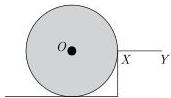
- A. Parallel to the pavement XY.
- B. Perpendicular to the radius at the point of contact.
- C. Along the line joining O and the point of contact.
- D. At a 45-degree angle to the pavement.
-
20.
[1]Why are racing cars designed to be very broad and very low in height?
- A. To increase the centre of gravity for better aerodynamics
- B. To keep the centre of gravity very low, ensuring stability during sharp turns at high speeds
- C. To reduce the weight of the car for higher speeds
- D. To allow for larger fuel tanks and more power
— End of paper —
New to AI Exam Master?
Chapter-wise practice, mock tests, AI tutor & the full ICSE syllabus — see everything on the main site.