ICSE Class 10
Biology
Human Population — Chapter Test
Time: 20 min
Maximum marks: 20
General instructions: Answer all questions. Marks are shown in brackets [ ].
Objective
-
1.
[1]What is the primary purpose of a 'Contraceptive' in the context of population control?
- A. To treat sexually transmitted infections
- B. To prevent pregnancy in individuals
- C. To enhance fertility in males and females
- D. To regulate hormonal imbalances in the body
-
2.
[1]Human population growth curve resembles a
- A. S-shaped curve
- B. J-shaped curve
- C. Zigzag curve
- D. None of the above
-
3.
[1]Which of the following is an advantage of having small families?
- A. Better quality of life with improved access to education, healthcare, and nutrition.
- B. Increased population growth leading to economic expansion.
- C. Higher consumption of resources boosting local industries.
- D. Greater financial burden due to increased dependency ratio.
-
4.
[1]Which of the following lists the three great cultural revolutions that favoured a steep rise in human population?
- A. Hunting revolution, Medical revolution, Technological revolution
- B. Tool making revolution, Agricultural revolution, Scientific industrial revolution
- C. Neolithic revolution, Urban revolution, Digital revolution
- D. Industrial revolution, Green revolution, Information revolution
-
5.
[1]Which of the following is a major disadvantage of having large families?
- A. Financial strain due to increased expenses on food, education, and healthcare.
-
6.
[1]What does the phrase "population explosion" refer to in the context of human populations?
- A. A sudden and massive decrease in the global population due to natural disasters or pandemics.
- B. The rapid and uncontrolled increase in the number of individuals, leading to insufficient resources and environmental challenges.
- C. A planned and regulated growth of the population to ensure economic stability and development.
- D. The migration of large populations from rural areas to urban centers for better opportunities.
-
7.
[1]Which statement best describes the environmental impact of urbanization?
- A. Urbanization is completely eco-friendly due to economic growth.
- B. Urbanization leads to pollution and deforestation but boosts employment.
- C. Urbanization has no impact on natural resources or ecosystems.
- D. Urbanization only benefits the environment by reducing rural populations.
-
8.
[1]What does the abbreviation 'IUD' stand for, and what is its primary function?
- A. Intra uterine device; prevents pregnancy by blocking implantation.
- B. Internal uterine device; treats infections in the uterus.
- C. Intravenous unit device; administers medication.
- D. Intra uterine drug; enhances fertility.
-
9.
[1]When the environmental resistance is negligible and there is plenty of food and space, the population would show
- A. Zero growth curve
- B. J-shaped growth curve
- C. Sigmoid growth curve
- D. none of the above
-
10.
[1]The diagram
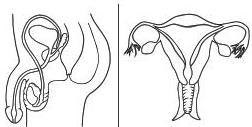 illustrates two sterilization methods. Which option correctly identifies them?
- A. Tubectomy in males and vasectomy in females.
- B. Tubectomy in females and vasectomy in males.
- C. Hysterectomy in females and circumcision in males.
- D. Laparoscopy in females and prostatectomy in males.
-
11.
[1]What is **sustainable development**, and which of the following best describes how it can be achieved?
- A. Meeting present needs without harming future generations, achieved by reducing resource use, reusing, recycling, and using renewable energy.
- B. Rapid industrial growth to maximize current production, even if it depletes resources for future generations.
- C. Focusing solely on economic growth by exploiting natural resources without considering environmental impact.
- D. Meeting present needs by prioritizing non-renewable energy sources and discarding waste without recycling.
-
12.
[1]Which of the following are two reasons for the rapid increase of population in India?
- A. High birth rate due to lack of awareness and access to family planning, and decline in death rate due to improved healthcare and sanitation.
- B. Increased immigration from neighboring countries and higher fertility rates due to government incentives.
- C. Improved education levels leading to delayed marriages and better employment opportunities reducing birth rates.
- D. Decrease in agricultural productivity and increased urbanization leading to higher birth rates.
-
13.
[1]Which TWO reasons explain the increase of population in India?
- A. High literacy rates and government family planning programs.
- B. Illiteracy and desire for a male child.
- C. Low infant mortality and increased immigration.
- D. Urbanization and access to contraceptives.
-
14.
[1]A teacher asked her students to identify two disadvantages of having a large family. Raj said: "Poor education and poor health." Sonu said: "Economic pressure and malnutrition." Lata said: "Better housing and higher per capita income." Abhay said: "Social neglect of children and economic prosperity." Who were correct?
- A. Raj and Sonu
- B. Sonu and Abhay
- C. Lata and Abhay
- D. Raj and Lata
-
15.
[1]Which factors contribute to the increased population in India?
- A. Late marriages, high death rates, and poor healthcare
- B. Early marriage, high birth rates, lack of family planning knowledge, and medical advancements
- C. Low fertility rates, urbanization, and education
- D. High emigration, low immigration, and economic decline
-
16.
[1](vii) A health organization wants to educate the rural audience about population control using visually engaging methods. Which of these would be effective? P: Posters Q: Loudspeakers R: Film shows S: Street plays
- A. P, R and S
- B. Q, R and S
- C. P, Q and R
- D. P, Q and S
-
17.
[1]What is the present rate of growth of the population of the world and of India?
- A. Global: 1% per year, India: 0.7% per year
- B. Global: 2% per year, India: 1.5% per year
- C. Global: 0.5% per year, India: 1.2% per year
- D. Global: 1.5% per year, India: 0.3% per year
-
18.
[1]What is the total world population at present?
- A. Approximately 6 billion
- B. Approximately 7 billion
- C. Approximately 8 billion
- D. Approximately 9 billion
-
19.
[1]What was the approximate Indian population according to the 1981 census, and what was it in 1991?
- A. 683 million in 1981 and 846 million in 1991
- B. 550 million in 1981 and 700 million in 1991
- C. 683 million in 1981 and 900 million in 1991
- D. 750 million in 1981 and 846 million in 1991
-
20.
[1]Darwin in his ‘natural selection theory’ did not believe in any role of which one of the following in organic evolution?
- A. Discontinuous variations
- B. Parasites and predators as natural enemies
- C. Survival of the fittest
- D. Struggle for existence
— End of paper —
New to AI Exam Master?
Chapter-wise practice, mock tests, AI tutor & the full ICSE syllabus — see everything on the main site.