ICSE Class 10
Mathematics
Circles (Tangent and Cyclic Properties) — Chapter Test
Time: 20 min
Maximum marks: 20
General instructions: Answer all questions. Marks are shown in brackets [ ].
Objective
-
1.
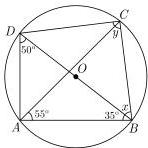
[1]In the given figure, $O$ is the centre of the circle. What are the values of $x$ and $y$?
- A. $85^{\circ}$ and $40^{\circ}$
- B. $20^{\circ}$ and $70^{\circ}$
- C. $40^{\circ}$ and $85^{\circ}$
- D. $70^{\circ}$ and $20^{\circ}$
-
2.
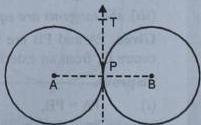
[1]In the given diagram, a point P is 17 cm away from the centre O of the circle, and the length of the tangent AP drawn from P to the circle is 15 cm. Which labelled segment represents the radius of the circle?
- A. OP
- B. AP
- C. OA
- D. PA
-
3.
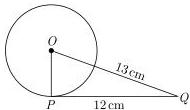
[1]From a point $Q$, the length of the tangent to a circle is $24\mathrm{cm}$ and the distance of $Q$ from the centre is $25\mathrm{cm}$. The radius of the circle is
- a. $7\mathrm{cm}$
- b. $12\mathrm{cm}$
- c. $15\mathrm{cm}$
- d. $24.5\mathrm{cm}$
-
4.
[1]In the given diagram, a chord AB of length 16 cm is drawn in a circle with centre O and radius 10 cm. OM is perpendicular to AB, meeting it at M. Which labelled segment represents the distance of the chord from the centre of the circle?
- A. OA
- B. OM
- C. AM
- D. AB
-
5.
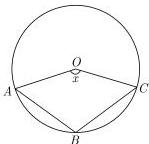
[1]What is value of angle $x$ in the given figure if $\angle ABC = 110^\circ$?
- a. $120^{\circ}$
- b. $150^{\circ}$
- c. $110^{\circ}$
- d. $140^{\circ}$
-
6.
[1]In figure, $O$ is the centre of circle. $PQ$ is a chord and $PT$ is tangent at $P$ which makes an angle of $50^\circ$ with $PQ$. $\angle POQ$ is:
- A. $130^{\circ}$
- B. $90^{\circ}$
- C. $100^{\circ}$
- D. $75^{\circ}$
-
7.
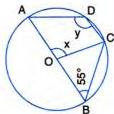
[1]In the given figure, O is the centre of the circle and ∠ABC = 55°. Identify the correct values of x and y from the labelled parts in the diagram.
- A. x = 110°, y = 70°
- B. x = 55°, y = 125°
- C. x = 110°, y = 110°
- D. x = 70°, y = 110°
-
8.
[1]In the given figure, BOA is a diameter of a circle and the tangent at point P meets BA produced at T. If ∠PBO = 30°, what is the measure of ∠PTA?
- A. 15°
- B. 30°
- C. 45°
- D. 60°
-
9.
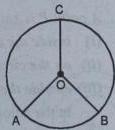
[1]In the given circle, chord AB is equal to chord CD. AB subtends ∠AOB and chord CD subtends ∠COD at the centre O. OA, OB, OC, and OD are joined.
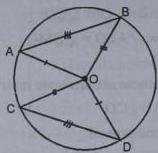 Which of the following correctly identifies the reason why ∠AOB is equal to ∠COD?
- A. Triangles OAB and OCD are congruent by the SSS axiom, so corresponding angles are equal.
- B. The angles are equal because both chords are equidistant from the centre.
- C. The angles subtended by any two chords at the centre are always equal.
- D. Triangles OAB and OCD are similar because all corresponding sides are equal.
-
10.
[1]In the given figure, $AB$ and $CD$ are two parallel chords of a circle with radius $15$ cm. If $AB = 24$ cm and $CD = 18$ cm, find the distance $MN$ between the two chords.

- A. $3$ cm
- B. $6$ cm
- C. $9$ cm
- D. $12$ cm
-
11.
[1]In the given figure, O is the centre of the circle and AB is a tangent at B. If AB = 15 cm and AC = 7.5 cm, what is the radius of the circle?
- A. 5.625 cm
- B. 7.5 cm
- C. 11.25 cm
- D. 15 cm
-
12.
[1]A quadrilateral circumscribes a circle with centre $O$. Which of the following must be true about the angles subtended by its opposite sides at the centre?
- A. They are equal.
- B. They are supplementary.
- C. They sum to 270°.
- D. They are complementary.
-
13.
[1]In the given figure, AB is the diameter of the circle with centre O. If ∠APB = x° and ∠BPR = y°, which of the following relationships must hold true?
- A. x° + y° = 90°
- B. x° + 2y° = 90°
- C. 2x° + y° = 90°
- D. x° - 2y° = 90°
-
14.
[1]In the given figure, ABCD is a cyclic quadrilateral whose side CD has been produced to E. If BA = BC and ∠BAC = 46°, which labelled angle corresponds to ∠ADE?
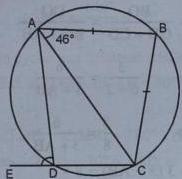
- A. The angle marked at vertex A inside the quadrilateral
- B. The exterior angle formed at point D by extending CD to E
- C. The angle at vertex C inside the quadrilateral
- D. The angle formed at point B by sides BA and BC
-
15.
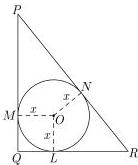
[1]For a right triangle with sides $a$, $b$, and hypotenuse $c$, a circle of radius $r$ touches all its sides. Which formula correctly relates $r$ to the sides?
- A. $r = \frac{a + b + c}{2}$
- B. $r = \frac{a + b - c}{2}$
- C. $r = \frac{a + c - b}{2}$
- D. $r = \frac{ab}{a + b + c}$
-
16.
[1]An isosceles Δ ABC is inscribed in a circle as shown in the diagram. AB = AC = 12√5 cm and BC = 24 cm. Which labelled part represents the radius of the circle?
- A. AM, the altitude from A to BC
- B. OM, the perpendicular from the centre to BC
- C. OA, the line from the centre to vertex A
- D. BM, half the length of base BC
-
17.
[1]A circle with centre O and diameter AB has chord AD. Another circle is drawn with AO as diameter to cut AD at C. Which relationship holds true?

- A. BD = OC
- B. BD = 2OC
- C. OC = 2BD
- D. BD = 3OC
-
18.
[1]In the given equilateral triangle ABC, the medians AD, BE, and CF intersect at point G, as shown in the diagram. Which labelled point or property in the diagram directly demonstrates that the centroid and the circumcentre coincide?
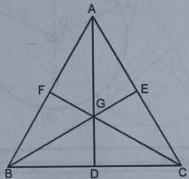
- A. Point G divides each median in a 2:1 ratio, making it the centroid only.
- B. The lengths GA, GB, and GC are equal, proving G is both centroid and circumcentre.
- C. The medians AD, BE, and CF are equal in length, confirming symmetry only.
- D. The angles at A, B, and C are each 60°, showing the triangle is equilateral only.
-
19.
[1]In the given figure, $D$ is a point on the circumcircle of $\Delta ABC$ where $AB = AC$, and $B$ and $D$ are on opposite sides of line $AC$. If $CD$ is produced to $E$ such that $CE = BD$, which of the following must be true?
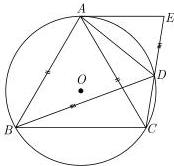
- A. $AD = AB$
- B. $AD = AE$
- C. $BD = AE$
- D. $AB = CE$
-
20.
[1]Two circles with centres A and B, and radii 5 cm and 3 cm, touch each other internally. If the perpendicular bisector of the segment AB meets the bigger circle in P and Q, find the length of PQ.
- A. 2√6 cm
- B. 4√5 cm
- C. 4√6 cm
- D. 8 cm
— End of paper —
New to AI Exam Master?
Chapter-wise practice, mock tests, AI tutor & the full ICSE syllabus — see everything on the main site.