ICSE Class 10
Biology
Cell Cycle and Structure of Chromosomes — Chapter Test
Time: 20 min
Maximum marks: 20
General instructions: Answer all questions. Marks are shown in brackets [ ].
Objective
-
1.
[1]Which term describes the division of the nucleus?
- A. Karyokinesis
- B. Cytokinesis
- C. Mitosis
- D. Meiosis
-
2.
[1]The cell component visible only during cell division
- A. Mitochondria
- B. Chloroplast
- C. Chromosome
- D. Chromatin
-
3.
[1]Cytoplasm.
- A. Inside the cell between the nucleolus and the centromere
- B. Inside the cell between the nucleus and the cell membrane
- C. Inside the cell between the mitochondria and the cell membrane.
- D. Inside the cell near to the cell membrane
-
4.
[1]________ is not a stage of mitosis.
- A. prophase
- B. Interphase
- C. Metaphase
- D. Anaphase
-
5.
[1]The process by which gametes are formed is called:
- A. Gametogenesis (Meiosis)
- B. Mitosis
- C. Fertilization
- D. Binary fission
-
6.
[1]The diagram shows a cell of an organism. The nucleus contains 12 chromosomes.
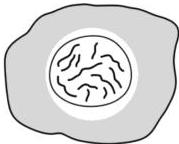 After it divides by mitosis, how many chromosomes would be present in one of the daughter cells?
- A. 6
- B. 12
- C. 18
- D. 24
-
7.
[1]Condensation of chromosomes with centromere formation occurs in which phase of interphase?
- A. S-phase
- B. G₁-phase
- C. G₂-phase
- D. Prophase
-
8.
[1]In the following diagram of a section of a DNA molecule, what is the part labelled Q?
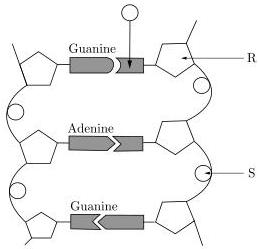
- A. Adenine
- B. Cytosine
- C. Thymine
- D. Uracil
-
9.
[1]A complex consisting of DNA strand and a core of histones is
- A. Nucleotide
- B. Nucleosome
- C. Centrosome
- D. Chromosome
-
10.
[1]The exchange of chromatid parts between the maternal and the paternal chromatids of a pair of a homologous chromosomes during meiosis is ________
- A. Crossing over
- B. Karyokinesis
- C. Meiosis
- D. Cytokinesis
-
11.
[1]Select the correct statement about $G_1$ phase:
- A. Cell is metabolically inactive.
- B. DNA in the cell does not replicate.
- C. It is not a phase of synthesis of macromolecules.
- D. Cell stops growing.
-
12.
[1]Which of the following correctly describes the relationship between cytokinesis and karyokinesis?
- A. Karyokinesis divides the nucleus; cytokinesis divides the cytoplasm afterward.
- B. Cytokinesis divides the nucleus; karyokinesis divides the cytoplasm afterward.
- C. Both processes occur simultaneously and divide the nucleus.
- D. Karyokinesis occurs only in plant cells; cytokinesis occurs only in animal cells.
-
13.
[1]During which stage of cell division do chromosomes arrange at the equator?
- A. Metaphase
- B. Prophase
- C. Anaphase
- D. Telophase
-
14.
[1]Which statement describes human cells formed by meiosis?
- A. They are genetically identical and they become gametes.
- B. They are genetically identical and they become tissues.
- C. They are not genetically identical and they become gametes.
- D. They are not genetically identical and they become tissues.
-
15.
[1]Which of the following correctly distinguishes between karyokinesis and cytokinesis?
- A. Karyokinesis divides the cytoplasm; cytokinesis divides the nucleus.
- B. Karyokinesis is the division of the nucleus; cytokinesis is the division of the cytoplasm.
- C. Karyokinesis occurs only in plant cells; cytokinesis occurs only in animal cells.
- D. Karyokinesis involves DNA replication; cytokinesis involves chromosome condensation.
-
16.
[1]At which point do duplicated chromosomes remain attached after DNA replication?
- A. Centromere
- B. Centrosome
- C. Telomere
- D. Kinetochore
-
17.
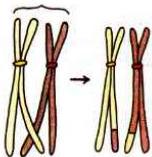
[1]The diagram given below represents a certain phenomenon which occurs during meiosis. Identify the labelled phenomenon using the terms — homologous chromosomes, chromatids, and crossing-over.
- A. Segregation of homologous chromosomes during anaphase I
- B. Exchange of segments between non-sister chromatids of homologous chromosomes, called crossing-over
- C. Random alignment of chromatids at the metaphase plate
- D. Separation of sister chromatids during anaphase II
-
18.
[1]Describe the role of mitochondria and chloroplasts during cell division. Which of the following statements best explains their behavior?
- A. They dissolve and are reassembled in daughter cells using nuclear DNA.
- B. They divide independently by simple fission and are distributed to daughter cells, guided by nuclear genes.
- C. They replicate only during interphase and are passively inherited by daughter cells.
- D. They fuse into a single structure before dividing equally between daughter cells.
-
19.
[1]The pairing of chromosomes during zygotene is known as:
- A. Synapsis
- B. Crossing over
- C. Disjunction
- D. Chiasma formation
-
20.
[1]How many mitotic divisions of a meristematic cell in a root tip are needed to produce 256 daughter cells?
- A. 8
- B. 16
- C. 32
- D. 64
— End of paper —
New to AI Exam Master?
Chapter-wise practice, mock tests, AI tutor & the full ICSE syllabus — see everything on the main site.