ICSE Class 10
Chemistry
Hydrogen Chloride (HCl) — Chapter Test
Time: 20 min
Maximum marks: 22
General instructions: Answer all questions. Marks are shown in brackets [ ].
Objective
-
1.
[1](XII) What is the balanced chemical equation for the reaction between hydrogen and chlorine?
- A. H₂ + Cl₂ → HCl
- B. H₂ + Cl₂ → 2HCl
- C. H₂ + 2Cl₂ → 2HCl
- D. 2H₂ + Cl₂ → 2HCl
-
2.
[1]Which gas is evolved when potassium sulphite is treated with dilute hydrochloric acid?
- A. Hydrogen sulphide
- B. Sulphur dioxide
- C. Chlorine
- D. Carbon dioxide
-
3.
[1](XV) What is the balanced chemical equation for the reaction between zinc and hydrochloric acid?
- A. Zn + HCl → ZnCl + H
- B. Zn + 2HCl → ZnCl₂ + H₂
- C. Zn + HCl → ZnCl₂ + H
- D. 2Zn + HCl → Zn₂Cl + H₂
-
4.
[1]Why is hydrogen chloride not collected over water?
- A. It is lighter than air.
- B. It is highly or extremely soluble in water.
- C. It reacts violently with water.
- D. It is a non-polar gas.
-
5.
[1]Why does hydrogen chloride gas produce fumes in moist air?
- A. It reacts with nitrogen in the air to form ammonia
- B. It reacts with atmospheric water vapour to form hydrochloric acid fumes
- C. It decomposes into hydrogen and chlorine gas
- D. It absorbs moisture and turns into a liquid
-
6.
[1](i) Manganese(IV) oxide, Lead(IV) oxide, Potassium permanganate, Potassium dichromate are commonly called as
- A. reducing agents
- B. oxidizing agents
- C. least volatile acids
- D. organic compounds
-
7.
[1]Why are thick white fumes formed when a glass rod dipped in NH₄OH is brought near the mouth of a bottle full of HCl gas?
- A. HCl gas reacts with ammonia from NH₄OH to form ammonium chloride, which appears as thick white fumes.
- B. HCl gas combines with water vapor in the air to produce white fumes of hydrochloric acid.
- C. The reaction between HCl and NH₄OH releases chlorine gas, which forms white fumes.
- D. NH₄OH decomposes into ammonia and water, and the ammonia reacts with oxygen to form white fumes.
-
8.
[1]Why are calcium oxide and phosphorus pentoxide not used to dry hydrogen chloride gas?
- A. They absorb HCl gas without reacting
- B. They react chemically with HCl, forming new compounds
- C. They are insoluble in HCl gas
- D. They decompose HCl into hydrogen and chlorine
-
9.
[1]Which balanced equation represents the reaction of zinc with dilute hydrochloric acid?
- A. Zn + 2HCl(dil.) → ZnCl₂ + H₂↑
- B. Zn + HCl(dil.) → ZnCl + H₂↑
- C. Zn + 2HCl(dil.) → ZnH₂ + Cl₂↑
- D. Zn + HCl(dil.) → ZnO + H₂ + Cl₂
-
10.
[1](XIII) Which of the following correctly represents the balanced chemical equation for the reaction between magnesium oxide and hydrochloric acid?
- A. MgO + HCl → MgCl + H₂O
- B. MgO + 2HCl → MgCl₂ + H₂O
- C. MgO + HCl → MgCl₂ + H₂
- D. 2MgO + HCl → Mg₂Cl + H₂O
-
11.
[1]Hydrogen chloride and water are examples of ______, and a solution of hydrogen chloride in water ______ free ions.
- A. polar covalent compounds, contains
- B. non-polar covalent compounds, contains
- C. polar covalent compounds, does not contain
- D. non-polar covalent compounds, does not contain
-
12.
[3]Choose the property of sulphuric acid (A, B, C, or D), which is relevant to each of the following: A
- A. Dilute acid (typical acid properties)
- B. Non-volatile acid
- C. Oxidising agent
- D. Dehydrating agent
-
13.
[1]Which balanced equation correctly represents the reaction of manganese(IV) oxide with concentrated hydrochloric acid?
- A. MnO₂ + 4HCl(conc.) → Δ MnCl₂ + 2H₂O + Cl₂
- B. MnO₂ + 2HCl(conc.) → Δ MnCl₂ + H₂O + Cl₂
- C. MnO₂ + 4HCl(conc.) → Δ MnCl₄ + 2H₂O
- D. MnO₂ + HCl(conc.) → Δ MnCl₂ + H₂O + O₂
-
14.
[1]Why is dilute hydrochloric acid not possible to concentrate by simple distillation?
- A. It forms a constant boiling mixture with water at 22.2% HCl by mass.
- B. HCl decomposes into hydrogen and chlorine gas when heated.
- C. Water evaporates first, leaving pure HCl behind.
- D. The solution becomes too dilute to distill effectively.
-
15.
[1]Phosphorus pentoxide and calcium oxide are good drying agents but they cannot be used to dry hydrogen chloride gas. Why?
- A. They react chemically with HCl, forming new compounds and destroying the gas.
-
16.
[1]Why is concentrated nitric acid not used in the preparation of hydrogen chloride gas?
- A. Concentrated nitric acid is volatile and contaminates the hydrogen chloride gas produced.
- B. Concentrated nitric acid reacts explosively with sodium chloride, the common reactant.
- C. Concentrated nitric acid is too weak to produce hydrogen chloride gas efficiently.
- D. Concentrated nitric acid forms a solid precipitate that blocks the apparatus.
-
17.
[1]A student wants to distinguish between manganese dioxide and copper(II) oxide using a chemical test. Which of the following observations would correctly identify manganese dioxide?
- A. Formation of a greenish-blue solution with no gas evolution
- B. Production of a greenish-yellow gas (chlorine) on heating with concentrated HCl
- C. Appearance of a white precipitate soluble in ammonium hydroxide
- D. Evolution of hydrogen gas when reacted with dilute HCl
-
18.
[1]Refer to the flow chart diagram below and identify the correct balanced equation with conditions, if any, for the conversion labelled **A**.
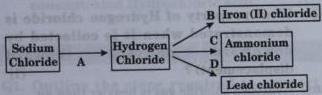
- A. NaCl + H₂SO₄ → NaHSO₄ + HCl (below 200°C)
- B. NaCl + H₂SO₄ → Na₂SO₄ + HCl (above 200°C)
- C. 2NaCl + H₂SO₄ → Na₂SO₄ + 2HCl (room temperature)
- D. NaCl + HCl → NaHSO₄ + H₂ (heating required)
-
19.
[1]How can you distinguish between Sodium sulphite and Sodium thiosulphate using dilute Hydrochloric acid?
- A. Both produce sulphur dioxide gas with no visible difference.
- B. Sodium sulphite produces sulphur dioxide gas, while sodium thiosulphate produces sulphur dioxide gas and a yellow precipitate of sulphur.
- C. Sodium sulphite produces a yellow precipitate, while sodium thiosulphate produces only hydrogen gas.
- D. Sodium thiosulphate produces sulphur dioxide gas, while sodium sulphite produces a colorless gas with no odor.
-
20.
[1]Which two compounds of Lead combine with concentrated hydrochloric acid to liberate chlorine gas?
- A. Lead monoxide and Lead sulphate
- B. Lead dioxide and Red lead (Pb₂O₄)
- C. Lead nitrate and Lead carbonate
- D. Lead acetate and Lead chloride
— End of paper —
New to AI Exam Master?
Chapter-wise practice, mock tests, AI tutor & the full ICSE syllabus — see everything on the main site.