ICSE Class 10
Mathematics
Similarity of Triangles — Chapter Test
Time: 20 min
Maximum marks: 20
General instructions: Answer all questions. Marks are shown in brackets [ ].
Objective
-
1.
[1]Sides of two similar triangles are in the ratio $4:9$. What is the ratio of areas of these triangles?
- A. $16:81$
- B. $81:16$
- C. $4:9$
- D. $9:4$
-
2.
[1]In the given diagram, $\triangle ABC \sim \triangle PQR$. If $AD$ and $PS$ are bisectors of $\angle BAC$ and $\angle QPR$ respectively then:
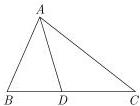
- a. $\triangle ABC \sim \triangle PQS$
- b. $\triangle ABD \sim \triangle PQS$
- c. $\triangle ABD \sim \triangle PSR$
- d. $\triangle ABC \sim \triangle PSR$
-
3.
[1]The perimeters of two similar triangles are 30 cm and 24 cm. If one side of the first triangle is 12 cm, what is the length of the corresponding side of the second triangle?
- A. 8 cm
- B. 9.6 cm
- C. 10 cm
- D. 15 cm
-
4.
[1]A rectangle having an area of 60 cm² is transformed under enlargement about a point in space. If the area of its image is 135 cm², find the scale factor of the enlargement.
- A. 0.5
- B. 1.5
- C. 2.0
- D. 2.25
-
5.
[1]A model of a ship is made to a scale of 1:200. If the length of the model is 4 m, what is the length of the actual ship?
- A. 800 m
- B. 0.02 m
- C. 80 m
- D. 200 m
-
6.
[1]The perimeters of two similar triangles are $25\mathrm{cm}$ and $15\mathrm{cm}$ respectively. If one side of the first triangle is $9\mathrm{cm}$, then the corresponding side of the second triangle is:
- A. $5.4 \mathrm{~cm}$
- B. $7.8 \mathrm{~cm}$
- C. $2.7 \mathrm{~cm}$
- D. $3.9 \mathrm{~cm}$
-
7.
[1]In the given diagram $\triangle ABC \sim \triangle EFG$. If $\angle ABC = \angle EFG = 60^\circ$, then the length of the side $FG$ is
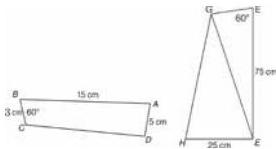
- a. $15\,\mathrm{cm}$
- b. $20\,\mathrm{cm}$
- c. $25\,\mathrm{cm}$
- d. $30\,\mathrm{cm}$
-
8.
[1]In the given figure,
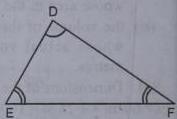 DE || BC. If DE = 4 cm, BC = 6 cm and area (Δ ADE) = 20 cm², which labelled part corresponds to the area of Δ ABC?
- A. The area of Δ ABC is 30 cm²
- B. The area of Δ ABC is 45 cm²
- C. The area of Δ ABC is 40 cm²
- D. The area of Δ ABC is 50 cm²
-
9.
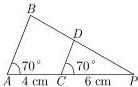
[1]In the given figure $\angle BAP = \angle DCP = 70^\circ$, $PC = 6\,\mathrm{cm}$ and $CA = 4\,\mathrm{cm}$, then $PD:DB$ is:
- a. $5:3$
- b. $3:5$
- c. $3:2$
- d. $2:3$
-
10.
[1]It is given that $\Delta ABC \sim \Delta PQR$ with $\frac{BC}{QR} = \frac{1}{4}$. Then $\frac{\operatorname{ar}(\Delta PRQ)}{\operatorname{ar}(\Delta BCA)}$ is equal to
- a. 16
- b. 3
- c. $\frac{1}{4}$
- d. $\frac{1}{16}$
-
11.
[1]A line PQ is drawn parallel to the side BC of Δ ABC which cuts side AB at P and side AC at Q. If AB = 9.0 cm, CA = 6.0 cm, and AQ = 4.2 cm, find the length of AP.
- A. 4.2 cm
- B. 6.3 cm
- C. 5.6 cm
- D. 7.0 cm
-
12.
[1]The areas of two similar triangles $ABC$ and $PQR$ are in the ratio 9:16. If $BC = 4.5\mathrm{cm}$, then the length of $QR$ is
- a. $4\mathrm{cm}$
- b. $4.5\mathrm{cm}$
- c. $3\mathrm{cm}$
- d. $6\mathrm{cm}$
-
13.
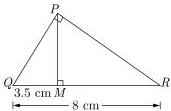
[1]In right-angled $\Delta QPR$, $PM$ is an altitude. Given $QR = 8$ cm and $MQ = 3.5$ cm, which of the following represents the length of $PR$?
- A. 4 cm
- B. 6 cm
- C. 7 cm
- D. 9 cm
-
14.
[1]Assertion (A): The ratio of the areas of two similar triangles is equal to the ratio of the squares of their corresponding sides. Reason (R): If two triangles are similar, their corresponding sides are proportional. Which of the following is correct regarding the assertion and reason above?
- A. Both assertion (A) and reason (R) are true, and reason (R) is the correct explanation of assertion (A).
- B. Both assertion (A) and reason (R) are true, but reason (R) is not the correct explanation of assertion (A).
- C. Assertion (A) is true, but reason (R) is false.
- D. Assertion (A) is false, but reason (R) is true.
-
15.
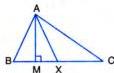
[1]In the given figure, triangle ABC is similar to triangle PQR. AM and PN are altitudes whereas AX and PY are medians.
 Which of the following correctly describes the relationship between the altitudes and medians of these similar triangles?
- A. AM/PN = AX/PY
- B. AM/AX = PN/PY
- C. AM + PN = AX + PY
- D. AM × PN = AX × PY
-
16.
[1]In Δ ABC, BM is perpendicular to AC and CN is perpendicular to AB. Which of the following correctly shows the similarity relationship and its consequences?
- A. Δ ABM ~ Δ ACN by AA similarity, so AB/AC = BM/CN = AM/AN
- B. Δ ABM ~ Δ ACN by SAS similarity, so AB/AC = BM/CN = AN/AM
- C. Δ ABM ~ Δ ACN by SSS similarity, so AB/AC = CN/BM = AM/AN
- D. Δ ABM ~ Δ ACN by AA similarity, so AB/AC = CN/BM = AN/AM
-
17.
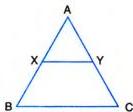
[1]In the given figure, ∠AXY = ∠AYX. If BX/AX = CY/AY, which labeled part or property directly confirms that triangle ABC is isosceles?
- A. AX = AY because triangle AXY is isosceles
- B. BX = CY due to the given ratio and AX = AY
- C. ∠B = ∠C as they are base angles of triangle ABC
- D. XY is parallel to BC, making the triangles similar
-
18.
[1]Two isosceles triangles have equal vertical angles. It is shown that the triangles are similar. If the ratio between the areas of these two triangles is 16 : 25, what is the ratio between their corresponding altitudes?
- A. 4 : 5
- B. 16 : 25
- C. 5 : 4
- D. 256 : 625
-
19.
[1]Triangle ABC is similar to triangle PQR. The bisector of angle BAC meets BC at point D and the bisector of angle QPR meets QR at point M. Which of the following relationships must hold true?
- A. AB/PQ = AD/PM
- B. AB/AD = PQ/PM
- C. AB/PQ = BD/QM
- D. AD/PM = BC/QR
-
20.
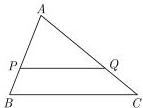
[1]In the given figure, $P$ and $Q$ are points on the sides $AB$ and $AC$ respectively of a triangle $ABC$. $PQ$ is parallel to $BC$ and divides the triangle $ABC$ into 2 parts, equal in area. The ratio of $PA:AB =$
- a. $1:1$
- b. $(\sqrt{2} - 1):\sqrt{2}$
- c. $1: \sqrt{2}$
- d. $(\sqrt{2} - 1):1$
— End of paper —
New to AI Exam Master?
Chapter-wise practice, mock tests, AI tutor & the full ICSE syllabus — see everything on the main site.