ICSE Class 10 Electricity and Magnetism — Mock Test (2027)
Free online mock test for Electricity and Magnetism (ICSE Class 10 Physics) — 20 competency-based questions based on the latest CISCE 2027 syllabus, with instant marking. Try the samples below, then take the full test free.
What to expect: This mock test covers key concepts from the Electricity and Magnetism chapter — including application-based and competency-focused questions aligned with how ICSE actually sets the paper.
Tip: Attempt without notes first to identify gaps, then review explanations for any wrong answers. Retake after a few days for best retention.
Sample questions
-
1.Fig. 8.37 shows a battery of e.m.f. 9 V and internal resistance 0.6 Ω, connected to three resistors A, B, and C. In the diagram, the resistor labelled **X** is the parallel combination of resistors B and C. What is the correct label for **X** in the circuit?
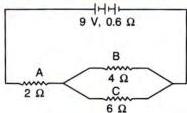
- A.2.4 Ω (combined resistance of B and C)
- B.4 Ω (resistance of B only)
- C.6 Ω (resistance of C only)
- D.4.4 Ω (total resistance of A, B, and C)
-
2.Calculate the heat energy given out by the filament of an electric bulb in 20 s when its resistance is 4 Ω and the potential difference across its ends is 12 V.
- A.360 J
- B.576 J
- C.720 J
- D.864 J
-
3.What is the voltage drop in a cell, and how is it related to the e.m.f. and terminal voltage?
- A.The voltage drop is the work done per unit charge inside the cell and equals the difference between e.m.f. and terminal voltage.
- B.The voltage drop is the terminal voltage of the cell and is always equal to the e.m.f.
- C.The voltage drop is the energy lost outside the cell due to external resistance.
- D.The voltage drop is the sum of the e.m.f. and terminal voltage of the cell.
-
4.Define the terminal voltage of a cell. How does it differ from the e.m.f. of the cell?
- A.Terminal voltage is the work done per unit charge to move a positive test charge around the entire circuit, including inside the cell, and equals the e.m.f.
- B.Terminal voltage is the work done per unit charge in carrying a positive test charge only outside the cell and is less than the e.m.f. due to internal resistance.
- C.Terminal voltage is the maximum potential difference a cell can provide and is always greater than the e.m.f. of the cell.
- D.Terminal voltage is measured in an open circuit, while e.m.f. is measured when the cell is connected to a circuit.
-
5.Which of the following correctly states two differences between an ohmic and non-ohmic resistor?
- A.Ohmic resistors do not obey Ohm's law; non-ohmic resistors obey Ohm's law. The V-I graph for both is linear.
- B.Ohmic resistors obey Ohm's law; non-ohmic resistors do not. The V-I graph for ohmic resistors is linear; for non-ohmic resistors, it is non-linear.
- C.Ohmic resistors have a non-linear V-I graph; non-ohmic resistors have a linear V-I graph. Both obey Ohm's law.
- D.Ohmic resistors change resistance with temperature; non-ohmic resistors maintain constant resistance. Both have linear V-I graphs.
Ready? Take the full 20-question test free — instant marking, no sign-up needed.
▶ Start free mock test