ICSE Class 10 Force, Turning Effects of Force, and Uniform Circular Motion — Mock Test (2027)
Free online mock test for Force, Turning Effects of Force, and Uniform Circular Motion (ICSE Class 10 Physics) — 20 competency-based questions based on the latest CISCE 2027 syllabus, with instant marking. Try the samples below, then take the full test free.
What to expect: This mock test covers key concepts from the Force, Turning Effects of Force, and Uniform Circular Motion chapter — including application-based and competency-focused questions aligned with how ICSE actually sets the paper.
Tip: Attempt without notes first to identify gaps, then review explanations for any wrong answers. Retake after a few days for best retention.
Sample questions
-
1.Assuming the centre of gravity of a uniform rod is at its midpoint, how can the position of the centre of gravity of a triangular lamina be determined?
- A.It is the intersection point of the medians (centroid) of the triangle.
- B.It is the midpoint of the longest side of the triangle.
- C.It is the average of the vertices' coordinates.
- D.It is the point where the altitudes of the triangle meet.
-
2.Which of the following is an example of a couple?
- A.Pushing a box across the floor
- B.Turning a water tap
- C.Lifting a weight vertically upward
- D.Pulling a rope tied to a fixed point
-
3.A uniform metre rule is pivoted at its mid-point. A weight of $50\mathrm{gf}$ is suspended at one end of it. Where should a weight of $100\mathrm{gf}$ be suspended to keep the rule horizontal?
-
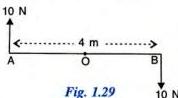
4.Two forces each of magnitude $10\mathrm{N}$ act vertically upwards and downwards respectively at the two ends A and B of a uniform rod of length $4\mathrm{m}$ which is pivoted at its mid point O as shown in Fig. 1.29. Determine the magnitude of resultant moment of forces about the pivot O.
-
5.What is meant by the term 'couple' in physics? State its effect and select the correct description from the options below.
- A.Two equal and opposite parallel forces whose lines of action do not coincide, producing rotation.
- B.Two forces acting in the same direction at different points, causing linear motion.
- C.A single force applied at a point, resulting in both translation and rotation.
- D.Two unequal forces acting in opposite directions, producing no net effect.
Ready? Take the full 20-question test free — instant marking, no sign-up needed.
▶ Start free mock test