ICSE Class 10 Heights and Distances — Mock Test (2027)
Free online mock test for Heights and Distances (ICSE Class 10 Mathematics) — 20 competency-based questions based on the latest CISCE 2027 syllabus, with instant marking. Try the samples below, then take the full test free.
What to expect: This mock test covers key concepts from the Heights and Distances chapter — including application-based and competency-focused questions aligned with how ICSE actually sets the paper.
Tip: Attempt without notes first to identify gaps, then review explanations for any wrong answers. Retake after a few days for best retention.
Sample questions
-
1.Find the height of a building, when it is found that on walking towards it 40 m in a horizontal line through its base the angular elevation of its top changes from $30^{\circ}$ to $45^{\circ}$.
-
2.From two points A and B on the same side of a building, the angles of elevation of the top of the building are 30° and 60° respectively. If the height of the building is 10 m, find the distance between A and B correct to two decimal places.
-
3.An observer, $1.5\,\text{m}$ tall is $20.5\,\text{m}$ away from a tower $22\,\text{m}$ high, then the angle of elevation of the top of the tower from the eye of observer is
- a.$30^{\circ}$
- b.$45^{\circ}$
- c.$60^{\circ}$
- d.$90^{\circ}$
-
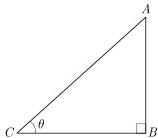
4.A vertical pole and a vertical tower are on the same level ground. From the top of the pole, the angle of elevation of the top of the tower is 60° and the angle of depression of the foot of the tower is 30°. If the height of the pole is 20 m, what is the height of the tower?
- A.40 m
- B.60 m
- C.80 m
- D.100 m
-
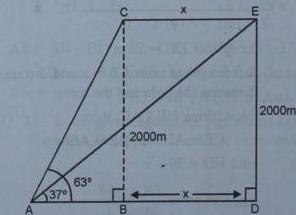
5.An aeroplane is flying horizontally 2000 m above the ground and is going away from an observer on the level ground. At a certain instant, the observer finds that the angle of elevation of the plane is $63^{\circ}$. After 15 seconds, its elevation from the same point changes to $37^{\circ}$. In the diagram below, which labelled segment represents the distance covered by the aeroplane in these 15 seconds?
- A.The vertical segment from the ground to the plane at the first observation.
- B.The horizontal segment between the two points directly below the plane at each observation.
Ready? Take the full 20-question test free — instant marking, no sign-up needed.
▶ Start free mock test